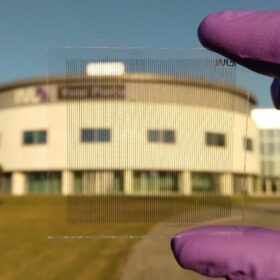
Improving solar windows via microfabrication techniques
Researchers in Europe are investigating semi-transparent solar windows, applying microfabrication technniques to both CIGS and perovskite devices, to overcome the view-impeding properties of earlier solar window concepts.
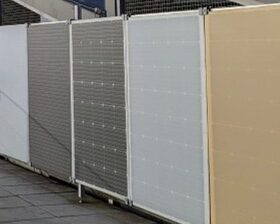
Glass-free, colored PV modules for building rooftop retrofits, façades
Researchers from Swiss and Austrian institutions have demonstrated a novel design for a glass-free, structurally robust silicon PV module. With a weight below 6 kg/m2, the targeted application is older buildings with weak roof structure.

Solar to power Denmark’s largest energy community
Denmark’s largest energy community is now under construction, featuring more than 30,000 sqm of solar rooftops with a total capacity of about 4 MW. The project will use building-integrated photovoltaics (BIPV) on pitched roofs and building-attached photovoltaics (BAPV) on flat roofs from Danish specialist Solartag.

Danish startup launches solar tile for pitched roofs
Solartag has developed a 71 W solar tile with a weight 14.2 kg/m² and a power conversion efficiency of 16%. The new product relies on black PERC cells and is standardized for mass production, according to the manufacturer.

Roofit Solar switches to TOPcon, adds color, and pitches PV to Prince of Wales
Integrating monocrystalline solar cells with metal standing seam roof panels, Roofit Solar sees opportunity in retrofit and new-build properties. pv magazine catches up with chief growth officer Greg Grace to discuss switching to TOPcon, adding color, energy security, and pitching rooftop solar to the Prince of Wales.
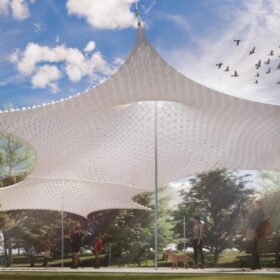
U.S. researchers developing photovoltaic dual-axis canopy
The “morphing skin” would track sunlight and have the flexibility and surface area to wrap across large surfaces, such as buildings and stadiums.
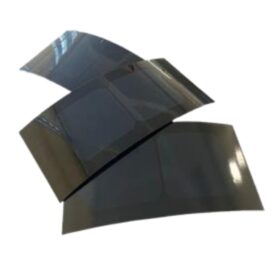
Izpitek unveils products to transform inert surfaces into PV systems
Izpitek is launching a new product line using patented tech to embed PV cells in composites, cutting weight by up to 95%.

Using laser processed glass as solar concentrators for BIPV
Researchers from Aalto University in Finland demonstrated a proof-of-concept of laser-processed glass to be used as a type of solar concentrator for building integrated PV (BIPV) applications. The treated glass enabled a 55-fold increase in photocurrent generation compared to unprocessed glass, with an estimated optical efficiency of 0.66 %. Additionally, a fluoropolymer coating was applied to create a self-cleaning surface.
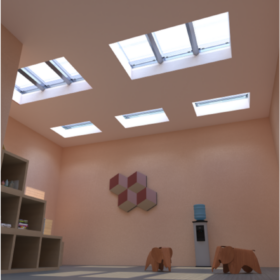
Semi-translucent solar window based on concentrated photovoltaics
Researchers in Spain have designed a PV window that performs active daylighting management while producing electricity. The system can reportedly ensure high power density, as it harvests all the direct light incident on the aperture area.
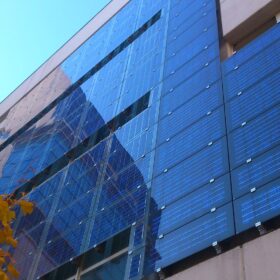
Technical guidebook for building-integrated photovoltaics
As the global transition toward sustainable energy intensifies, building-integrated photovoltaics (BIPV) has emerged as a critical innovation in merging renewable energy with architectural design. The recently published guidebook “Building-Integrated Photovoltaics: A Technical Guidebook,” edited by IEA PVPS Task 15 experts Nuria Martín Chivelet, Costa Kapsis, and Francesco Frontini, offers a comprehensive resource for architects, engineers, and urban planners looking to integrate BIPV into the built environment. This article explores the book’s key insights, including applications, challenges, and future pathways.
