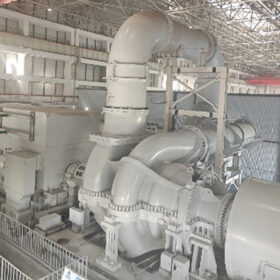
Chinese Academy of Sciences unveils 101 MW compressor for compressed air energy storage
The new compressor is described as the world’s most powerful single-unit compressed air energy storage (CAES) system, with a maximum discharge pressure of 10.1 MPa and an efficiency of 88.1%.
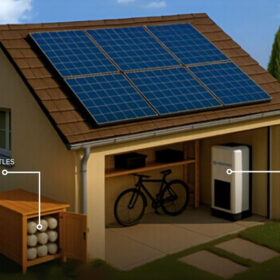
Segula presents compressed air storage system for residential applications
The system consists of a reversible compressor connected to a storage unit that can be installed indoors or outdoors. The compressor must be connected to the solar panels, with the whole system being controlled by an application that optimizes self-consumption.
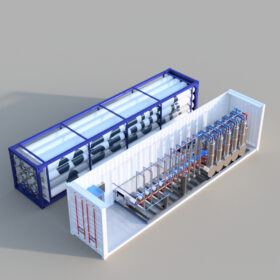
Compressed air energy storage system for homes, businesses
Segula Technologies has launched its Remora Stack product, a containerized isothermal air compression storage solution the company claims is 70% efficient.
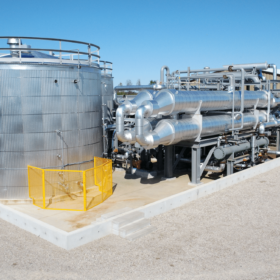
Australia gives go-ahead to its first compressed air storage project
Broken Hill is closer to becoming one of the world’s largest renewable energy microgrids with the New South Wales (NSW) government giving planning approval for a compressed air energy storage (CAES) facility near the historic mining town.
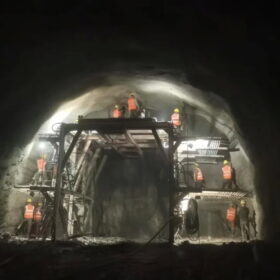
Chinese consortium building 1.2 GWh compressed air energy storage project
A state-backed consortium is constructing China’s first large-scale compressed air energy storage (CAES) project using a fully artificial underground cavern, marking a major step in the technology’s commercialization.

World’s largest compressed air energy storage facility commences full operation in China
A 300 MW compressed air energy storage (CAES) power station utilizing two underground salt caverns in central China’s Hubei Province was successfully connected to the grid at full capacity, making it the largest operating project of the kind in the world.
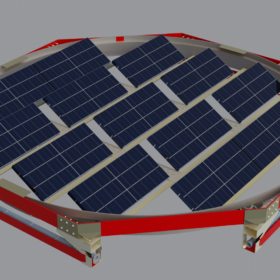
Combining floating PV with compressed air energy storage
Researchers from Egypt and the UK developed a new floating PV system concept that utilizes compressed air for energy storage. The system has a roundtrip efficiency of 34.1% and an exergy efficiency of 41%.
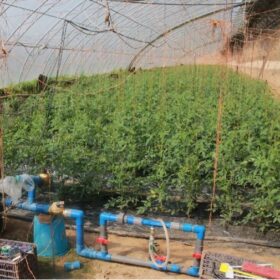
PV-driven drip irrigation system with compressed air storage
The proposed system uses compressed air to store energy, as well as for the prevention of clogging in the irrigation tubes. Two experimental systems were built and tested in China and clogging was reduced by up to 93%.
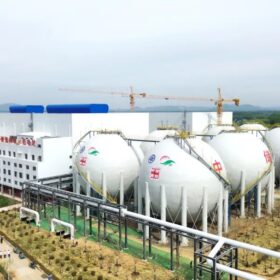
World’s largest compressed air energy storage project comes online in China
Zhongchu Guoneng Technology Co., Ltd. (ZCGN) has switched on the world’s largest compressed air energy storage project in China. The $207.8 million energy storage power station has a capacity of 300 MW/1,800 MWh and uses an underground salt cave.
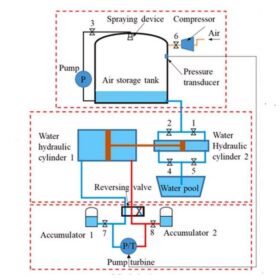
Integrating pumped hydro with compressed air energy storage
A group of Chinese researchers has made a first attempt to integrate pumped hydro with compressed air storage and has found the latter may help the former to better deal with large head variations.
