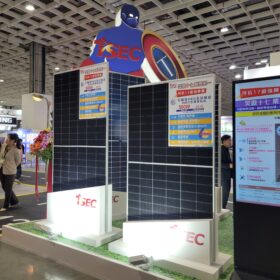
TSEC unveils typhoon resistant glass-glass solar modules
The Taiwanese manufacturer showcased the new module range at Energy Taiwan trade show. Two modules in the lineup boast a wind resistance of 17 on the Beaufort scale, making them typhoon ready, according to the company.

A better understanding of UV degradation
Performance loss from ultraviolet (UV) light has become a concern for new PV cells, though earlier lab tests may have overstated the issue. Paul Gebhardt, photovoltaic module reliability scientist at Fraunhofer Institute for Solar Energy Systems (ISE), outlines a mechanism that may have distorted earlier results.

Perovskite rollout gathers pace
Perovskite’s growing visibility at industry events in 2025 is a sign that perovskites have progressed beyond the small lab-made devices seen earlier this decade. The focus is now on developing materials, processes, and a supply chain ready for large-scale manufacturing and deployment.

Roofit Solar switches to TOPcon, adds color, and pitches PV to Prince of Wales
Integrating monocrystalline solar cells with metal standing seam roof panels, Roofit Solar sees opportunity in retrofit and new-build properties. pv magazine catches up with chief growth officer Greg Grace to discuss switching to TOPcon, adding color, energy security, and pitching rooftop solar to the Prince of Wales.

pv magazine Roundtables Europe: EU guidance for PV confirmed in agrivoltaics session
The European Commission will publish guidance on agrivoltaics as part of a wider document covering innovative technologies, attendees at pv magazine Roundtables Europe 2024 heard. More than 1,300 guests joined pv magazine’s live event on Dec. 5, which covered topics ranging from quality and European manufacturing to energy storage and solar cell technology.
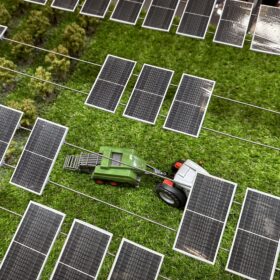
‘The crop people don’t understand the PV aspect’
University of Exeter academic Aritra Ghosh tells pv magazine a multidiscipline approach is required to unlock the full potential of agrivoltaics. Discussing a new paper comparing static and tracker agrivoltaics systems in the United Kingdom, the researcher argues better understanding of microclimates under modules and how PV affects crop biochemistry is needed.

JinkoSolar claims 26.89% efficiency rating for new N-type solar cell
JinkoSolar claims that its new 182 mm n-type monocrystalline silicon solar cell has reached a maximum solar conversion efficiency of 26.89%. It says the achievement has been independently verified by a third party.
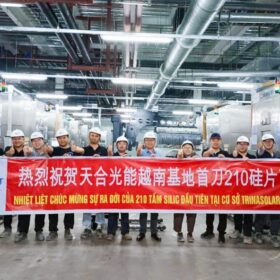
Trina Solar begins producing 210 mm wafers at 6.5 GW Vietnam facility
In addition to the new factory’s wafer production capacity of 6.5 GW, it has a cell capacity of 4 GW and a module capacity of 5 GW.
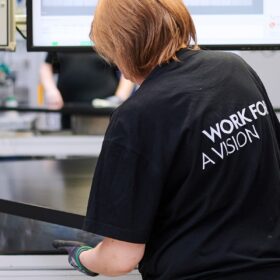
Meyer Burger shifting focus to US market
Meyer Burger is now prioritizing the establishment of new module and cell production facilities in the United States, driven by favorable market conditions in the country.
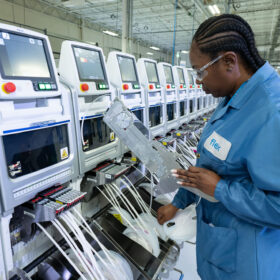
US solar market reshores energy supply chain following passage of IRA
The US solar market has started to reshore its energy supply chain, just one year after the passage of the US Inflation Reduction Act (IRA).
