
Tanzanian utility issues EPC tender for 100 MW solar plant
Tanzania Electric Supply Co. Ltd. (Tanesco) is seeking engineering, procurement and construction (EPC) contractors for a 100 MW PV facility to be built in the country’s Shinyanga Region.
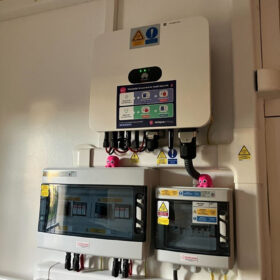
French solar-plus-storage product ‘could provide grid flexibility of six nuclear reactors’
Octopus Energy Services has responded to the government’s decision to slash the payments made to solar home owners for their excess electricity by launching its SolarPlus, home solar-plus-battery product.

Scientists testing perovskite-silicon tandem solar cells with interdigitated back contacts
A research team in Iran has designed a four-terminal perovskite-silicon tandem solar cells with a 19.3%-efficient bottom heterojunction cell and a 12.7%-efficient perovskite top cell. Both subcells were conceived to have interdigitated back contacts, with the top cell reportedly helping to improve the tandem device’s light-trapping and efficiency.

Lithuania deploys 870 MW of solar in 2024
Lithuania added record solar capacity in 2024, pushing cumulative installations to nearly 2 GW, driven largely by residential systems and a favorable regulatory framework.

Oxford PV, Trina Solar enter patent licensing agreement for perovskite-silicon tandem solar
The exclusive license agreement covers the manufacture or sale of perovskite PV products for the Chinese market. A statement from Oxford PV says the agreement “underscores the industry consensus that perovskite-based PV technologies are the future of solar.”

Current UV tests overestimate TOPCon solar module degradation
Fraunhofer Institute for Solar Energy Systems ISE (Fraunhofer ISE) has found that current UV testing methods overestimate degradation in tunnel oxide passivated contact (TOPCon) solar modules, as dark storage after UV exposure causes temporary efficiency losses that largely reverse under sunlight.

Tender opens for solar minigrids in Fiji
The United Nations Development Programme (UNDP) is running a tender for solar minigrids and communication infrastructure in rural areas of Fiji. The deadline for submitting expressions of interest is April 17.
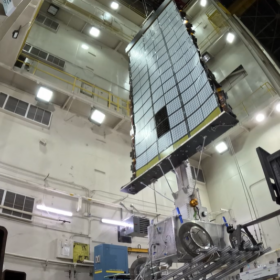
Lockheed Martin developing vertical solar arrays for the Moon
The defense and aerospace company’s vertical solar array technology (VSAT) reaches up to 19.8 m in length. Lockheed Martin says the technology is capable of providing continuous and sustainable power for a range of lunar operations.

India adds 25.3 GW of module capacity, 11.6 GW of cells in 2024
Indian manufacturers built 25.3 GW of solar module manufacturing capacity in 2024, taking the nation’s panel capacity to 90.9 GW as of Dec. 31, 2024.
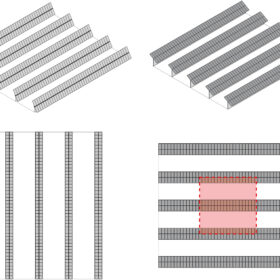
New simulation framework achieves higher dual land use efficiency in agrivoltaics
Researchers in Italy have conceived new agrivoltaic modeling for agrivoltaics that includes crop yield response curves for multiple crops. Once the electricity production coming from the PV modules is also assessed, the performance metrics for the agrivoltaic system as a whole are obtained.
