
Solar cell based on high-entropy hybrid perovskite achieves 25.7% efficiency
Researchers in China have built for the first time an inverted perovskite solar cell relying on a high-entropy hybrid perovskite material. The result is a device with an improved open-circuit voltage and fill factor, due to reduced non-radiative recombinations and optimized interface.
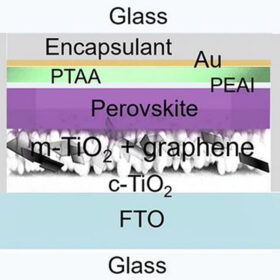
New encapsulant for perovskite solar cells, modules withstands multiple accelerated ageing tests
Researchers in Italy have developed a low temperature a blanket-cover encapsulation technique that reportedly improves the stability of perovskite PV devices. They said the new technique reduces thermomechanical stresses caused by both the encapsulation process and the temperature gradients occurring during accelerated ageing stresses.
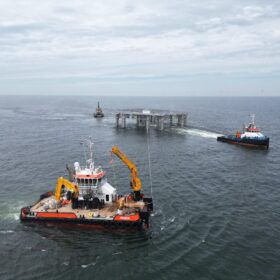
SolarDuck, RWE install offshore floating solar pilot in North Sea
RWE and SolarDuck have built a 0.5 MWp offshore floating solar pilot project in the North Sea, 12 km off the Dutch coast. The installation features six interconnected platforms capable of withstanding extreme offshore conditions.

South Africa imposes 10% import tariff on solar panels
The International Trade Administration Commission of South Africa (ITAC) has imposed a 10% import tariff on solar panels to protect local manufacturers, attract investment, and deepen the value chain. The South African Photovoltaic Industry Association has questioned the lack of formal industry engagement, calling the timing “not ideal.”

Colombia’s PV capacity hits 1.2 GW
Colombia’s Mining and Energy Planning Unit (UPME) says the country’s PV capacity has reached 1,193 MW. The nation surpassed the 1 GW threshold several weeks ago with the commissioning of two large-scale solar facilities.
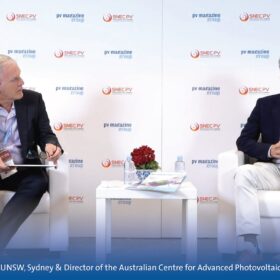
Imminent introduction of perovskite-silicon tandems is unlikely, says Prof. Martin Green
At SNEC 2024 in Shanghai, pv magazine spoke with Martin Green, Scientia Professor at the University of New South Wales and solar cell technology expert. He said perovskite-silicon tandem technologies still have a long way to go before reaching commercial maturity and predicts silicon-based technologies will still dominate the market for many years. He also sees potential for copper zinc tin sulfide (CZTS) solar cells and other absorber materials. “Until we don’t solve the stability issues with perovskite, is good to have other candidates,” he stated.
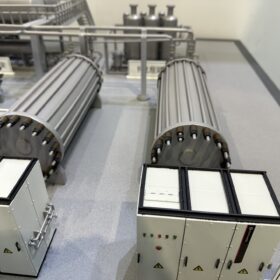
Optimal size ratios for solar, wind-powered hydrogen production
Researchers in Italy outlined a new model for estimating hydrogen production cost as a function of the plant’s component sizes. They tested both PV, wind, and hybrid production of hydrogen to determine the optimal size ratio for the 2030-2050 period. They also found that PV-powered hydrogen may currently achieve a levelized cost of hydrogen of €5.11/kg in Italy, with a PV ratio of 2.2.
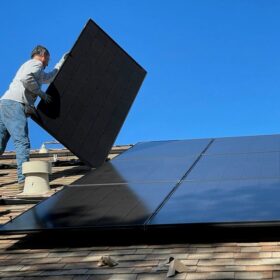
Canada’s B.C. Hydro to offer solar, battery rebates
Homeowners in the Canadian province of British Columbia who install rooftop solar and battery energy storage systems will soon be able to apply for up to CAD 10,000 ($7,341) in rebates from electric utility B.C. Hydro.
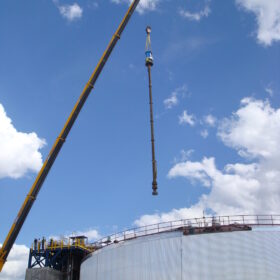
Sulzer supplies molten salt pumps for 100 MW solar tower in China
Sulzer, a Switzerland-based fluid engineering specialist, has supplied molten salt pumps for a 100 MW concentrated solar power (CSP) project in China. The facility is designed to provide solar power 24 hours a day.

Maldives opens tender for grid-tied solar-plus-diesel plants
The government of the Maldives is accepting bids for the design, supply and installation of grid-tied solar-diesel hybrid power generation plants. The projects will be built on nine inhabited islands across the country.
