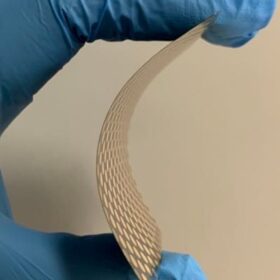
Cadmium telluride solar cell based on indium gallium oxide emitter achieves 17.2%
Developed by the University of Toledo, the cell achived the highest efficiency ever reported for flexible cadmium telluride solar cells to date. The device reached an open-circuit voltage of 861 mV, a short-circuit density of 27.8 mA/cm2, and a fill factor of 71.7%.
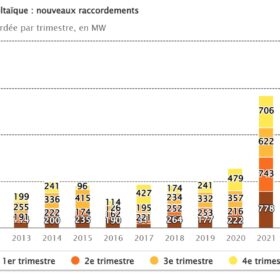
France hits 20 GW milestone
France added around 3.2 GW of new PV capacity in 2023, with about 955 MW in the fourth quarter alone. The nation hit 20.0 GW of total installed PV capacity at the end of December 2023.
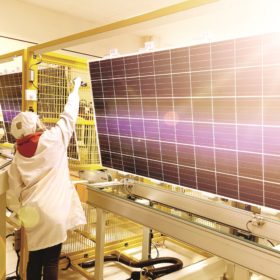
Chinese PV Industry Brief: Canadian Solar, Aiko Solar to build new factories
Canadian Solar says its new 14 GW vertically integrated cell and module factory will require an investment of CNY 9.63 billion ($1.33 billion), while Aiko Solar says it will invest CNY 9.97 billion in a 10 GW facility.

New design for photovoltaic-thermal panels mitigates risk of cracking
Researchers in Sweden have developed a new PVT module using an aluminum alloy structure between the thermal absorber and the photovoltac cells. This architecture reportedly reduces thermal expansion by 20%, thus increasing the chances of mitigating cracks in the PV unit.
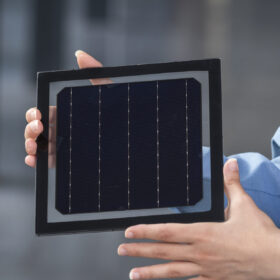
Fraunhofer ISE develops vacuum deposition process for perovksite-silicon tandem solar cells
The German research institute is investigating the use of commercially available vacuum-based evaporation equipment to manufacture perovskite thin films and contacts layers in the fabrication of perovskite-silicon tandem cells.
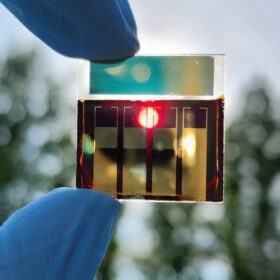
Korean scientists build semi-transparent perovskite solar cell with record-breaking efficiency of 22.02%
Developed by researchers at the Korea Institute of Energy Research (KIER), the novel cell was conceived for applications in bifacial perovskite-silicon tandem PV devices. The academics claim they were able to overcome an intrinsic dopant-induced internal degradation mechanism which leads to undesired lithium-ion diffusion that would have been detrimental to the cell efficiency.
EDP Renewables wins Singapore’s largest public solar tender
EDP Renewables has won Phase 8 of Singapore’s SolarNova program, the country’s largest public solar tender to date. The developer will install up to 200 MWp of rooftop PV capacity.
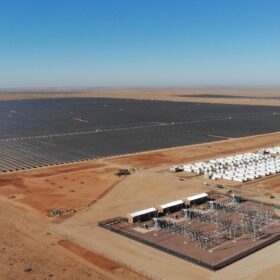
Scatec provides update on African PV projects
Terje Pilskog, the CEO of Norwegian developer Scatec, recently spoke to pv magazine about the company’s PV projects in South Africa, Botswana and Egypt. He said financing remains a critical hurdle to deploy solar across the continent.
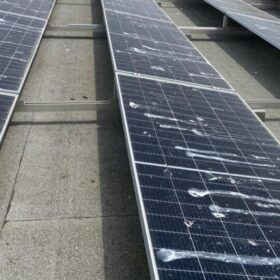
Spanish company offers harmless device protecting solar modules from birds
Prosolarbirds has designed a harmless device to prevent birds from perching on the panels and soiling them with excrement. It is a rotating device, without a motor, that is activated by a slight breeze, and whose movement prevents birds from landing.
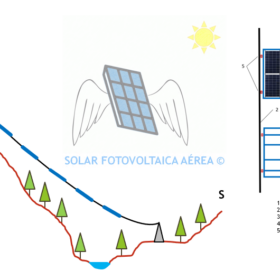
Mine engineers develop air PV for applications in limited spaces
Engineers in Spain have developed a PV system solution that uses steel cables as a mounting structure. They say it is deployable in different scenarios with limited space.
