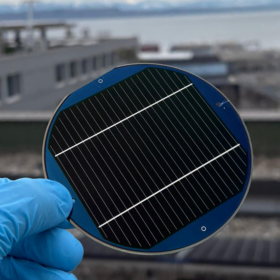
EPFL, CSEM achieve world record efficiency of 30.02% in perovskite-silicon triple-junction solar cell
An international research team boosted triple-junction solar cell performance by enhancing perovskite crystal growth, increasing middle-cell light absorption, and adding reflective nanoparticles.
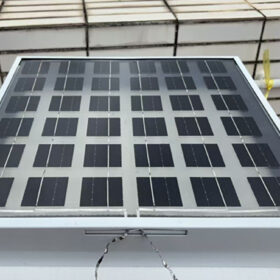
Thermochromic bifacial PV glazing system for reducing building cooling loads
Researchers in Hong Kong Hong Kong fabricated a thermochromic bifacial photovoltaic glazing system prototype that passively regulates solar heat gain while harvesting energy from both sides. Experiments and simulations showed it significantly reduces cooling loads and indoor temperatures while boosting electricity generation.

Ariston launches residential propane heat pump with built-in PV function
The Italian heating solutions provider said its new Nuos Plus S2 Wi-Fi heat pump system offers up to 80% energy savings and a coefficient of performance of up to 3.51.
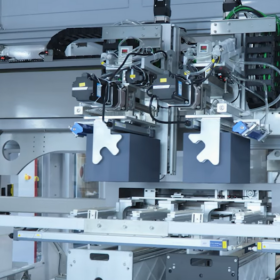
India’s PV module manufacturing capacity tops 210 GW
India added 119 GW of solar module capacity and over 9 GW of cell capacity in 2025, bringing total capacities to about 210 GW and 27 GW, respectively, according to Mercom India. Growth was driven by strong project demand and policy support, although supply-demand alignment is expected later in 2026 as domestic cell production ramps up.

China’s new five-year plan deepens shift toward focus on renewables system
China’s 2026 to 2030 policy plan elevates clean electricity as a central driver of economic growth, with greater emphasis on system integration and industrial use.

Survey reveals PV systems in Germany outperform lifespan expectations
Researchers analyzed 16 years of data from over 1 million PV systems in Germany and found annual degradation is just 0.52–0.61%, roughly half prior estimates. Environmental factors like heat, frost, and air pollution affect performance, while smaller systems degrade less than larger ones, boosting long-term reliability and profitability.

France selects six operators for PV module recycling capacity
France’s solar recycling body has selected Envie 2E, Galloo, Rosi, RVE, and First Solar to manage rising volumes of end-of-life panels, with combined capacity exceeding 45,000 metric tons (MT) per year.
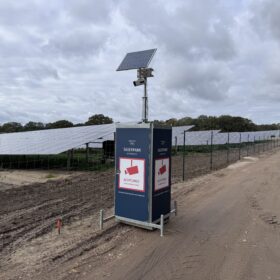
How EU NIS2 is reshaping physical and cybersecurity for PV plant operators
The European Union’s NIS2 Directive is pushing PV operators to strengthen both cyber and physical security, treating solar assets as critical infrastructure. It also highlights the need for stronger physical protection measures, such as site surveillance, access control, and perimeter security to prevent tampering and intrusion.
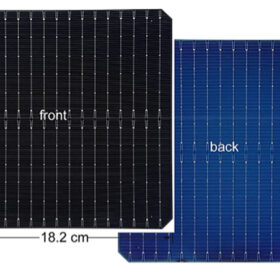
Discovery of passivating pinholes in TOPCon solar cells paves the way for higher efficiencies
DAS Solar and Hebei University have identified two types of pinholes in TOPCon solar cells: harmful recombinational pinholes, which lack oxygen and cause carrier recombination, and beneficial passivating pinholes, which retain oxygen to enable efficient tunneling while maintaining interface passivation. Their work shows that optimizing oxide layer formation, back-surface polishing, and polycrystalline silicon deposition can increase passivating pinholes, boosting device efficiency and guiding industrial cell design.
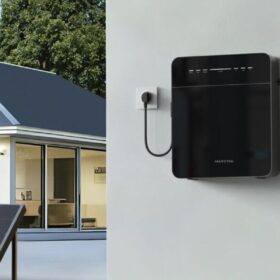
Marstek launches 2 kWh plug-in battery storage system
Marstek has unveiled a plug-in storage system with a two-kilowatt-hour capacity. The device plugs into a standard household socket and is designed to store solar power from balcony systems or draw in cheap electricity from dynamic pricing tariffs.
