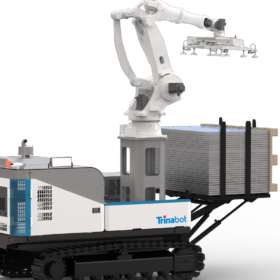
Trinabot offers installation robots for large PV projects
The China-based technology and solar infrastructure company has launched Buildex, a line of solar panel installation robots. A built-in forklift, a robotic arm and advanced automation software support its ability to carry, pick and place panels in a variety of terrains.
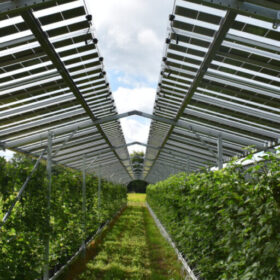
Germany offers best European policy for agrivoltaics, claim researchers
Scientists in Canada studied romaine lettuce growth under cadmium telluride thin-film solar modules with varying transparency and photosynthetically active radiation, and found Germany’s regulatory framework most effective for maximizing agrivoltaic benefits.

Improving PV cleaning schedules without large datasets
Scientists in Algeria have developed a low-cost solution to optimize cleaning operations for all PV systems. The proposed approach works “effectively” without heavy data requirements, according to its creators.

Agrivoltaics for sugarcane
Brazilian scientists have investigated the potential of agrivoltaics on sugarcane fields and have found this combination may provide benefits in terms of both agricultural and electricity yield. Their results showed that under certain conditions the sugarcane yield below the panels can be higher than that of plots without PV.
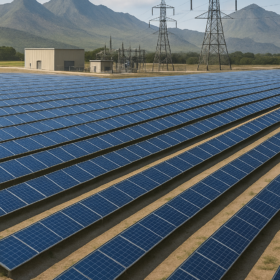
How to control frequency fluctuations during PV plant deloading
Researchers in Egypt have developed new control strategies for managing frequency fluctuations during deloading of a photovoltaic plant. The proposed methodology combines a proportional–integral controller along with a rate of change of frequency controller.
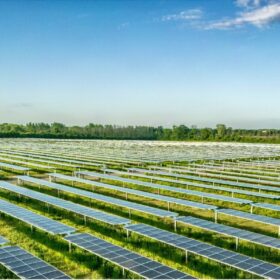
FTC Solar introduces solar tracker for high wind regions
The 1P single-axis tacker is engineered to withstand winds up to 150 mph.
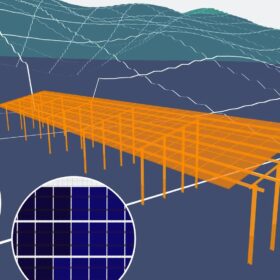
PVFarm enhances tracker, terrain tools for large-scale PV planning
The U.S. software company has improved its single-axis tracker and fixed tilt configurators for planning large-scale projects, adding customization features and additional support for terrain-conforming designs.
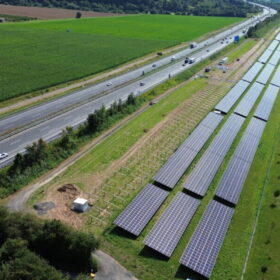
Germany allocates 2.27 GW in latest utility-scale PV tender
Germany’s latest auction for utility-scale solar concluded with prices ranging from €0.0400 ($0.0467)/kWh to €0.0626/kWh. The procurement exercise was oversubscribed.
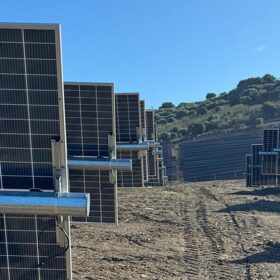
PV Hardware offers new terrain-following tracker solution
The Spain-based manufacturer announced terrain-conforming tracker support, enabling up to 2° of variation between posts. The new solution is meant to enable solar PV on more difficult sites without increasing environmental impact or construction costs.
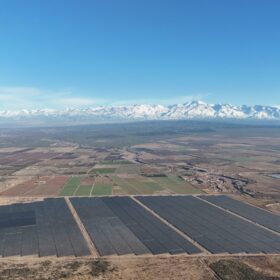
Genneia switches on 180 MW solar park in Argentina
Argentina’s Genneia has begun commercial operations at the 180 MW Anchoris solar park in Mendoza province, a $160 million project aimed at supplying large industrial consumers through the country’s Renewable Energy Futures Market.
