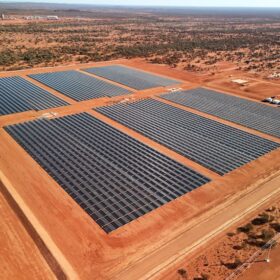
Australian miner energizes 95 MW offgrid wind-solar-storage plant
Australian miner Liontown Resources has flicked the switch on one of the largest off-grid renewable energy hybrid power stations in Australia.

Renewable energy benefits surpass estimates, says Berkeley Lab
The Lawrence Berkeley National Laboratory says benefits from lower emissions are more significant than most prior estimates.
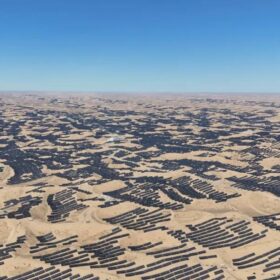
World’s largest solar plant goes online in China
China Green Development Group has switched on the 3.5 GW Midong solar project in Urumqi, China’s Xinjiang region. The project required an investment of CNY 15.45 billion ($2.13 billion).

U.S. commercial real estate to host VPP-connected flywheels and batteries
US-based technology provider Torus has agreed to supply nearly 26 MWh of energy storage for Gardner Group’s commercial real estate portfolio. The project will integrate battery and flywheel energy storage systems (BESS, FESS) with Torus’ proprietary energy management platform.

Kosovo opens subsidy scheme for solar thermal systems
Household consumers in Kosovo can now apply for a subsidy to install a solar system for heating sanitary water. Applications to the first of two stages are open until August 31.

Colbún proposes 800 MW desalinated water-powered pumped storage project in Chile
Chilean utility Colbún has unveiled plans for a massive pumped storage hydropower project in northern Chile. The facility will use desalinated water from the Pacific Ocean to store energy and use it when it’s most needed.
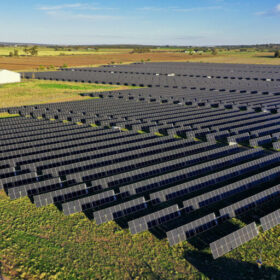
Australian property giant signs first-ever matched energy supply deal
Enosi Energy has signed a first-of-its-kind initiative with real estate investment business EG Funds by using a matched energy supply agreement to bulk up renewable energy used by commercial properties in Sydney, Australia.
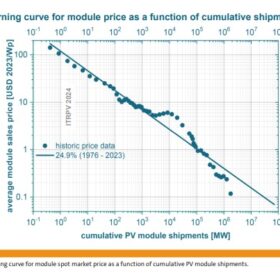
ITRPV says solar module prices fell 50% in 2023
The new edition of the International Technology Roadmap for Photovoltaic (ITRPV), published this week, reveals that the world’s installed PV capacity reached 1.6 TW at the end of last year. The learning curve, which reflects average module prices relative to cumulative shipments, is 24.9% for the period from 1976 to 2023.
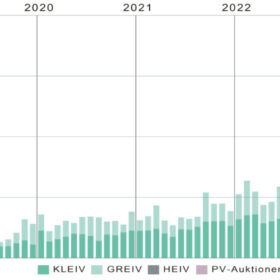
Switzerland’s solar installations hit 602 MW in January-April
Switzerland installed 602 MW of solar in the first four months of the year, bringing its total installed PV capacity to around 6.8 GW by the end of April.
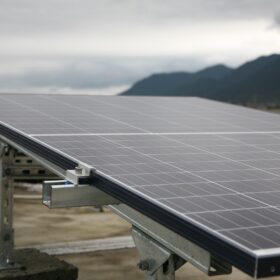
Low tilt angles ideal for regions with high summer load demand
New research from India shows the advantages of deploying fixed tilt PV systems with low angles in regions with high summer load demand like India. The scientists said that, although PV systems with low tilt angles may not achieve maximum power yield or the lowest levelized cost of energy (LCOE), they can reduce reliance on expensive grid electricity during high-demand periods.
