
Pressure brings sweltering sun and soaking rain: July extremes in America
In a new weekly update for pv magazine, Solcast, a DNV company, presents the solar irradiance data it collected for North America this month. July’s high pressure in the southwest and trough in the northeast dramatically influenced the region’s solar energy production. Persistent high-pressure systems in the southwest led to frequent clear skies and warm air masses, driving up solar irradiance and enhancing potential solar power generation.
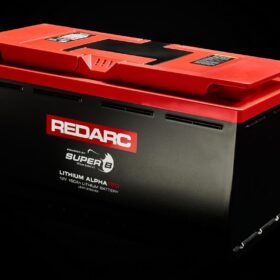
Redarc unveils 150 Ah lithium battery
The Alpha 150 battery, produced in the Netherlands by Australian electronics manufacturer Redarx, has a lifespan of more than 5,000 cycles and a continuous discharge rating of 200 A.

Greece’s PV fleet keeps power system running during heatwave
Greece is experiencing consecutive heatwaves and a number of forest fires this month that have increased demand for electricity. The country’s solar photovoltaic fleet is keeping the power system running at peak times.
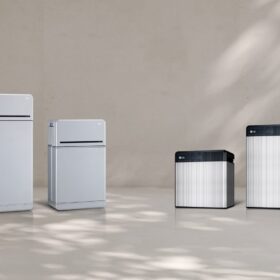
LG launches residential hybrid inverters for European market
South Korea’s LG Energy Solution says its new hybrid inverters are suitable for high-voltage and low-voltage configurations.
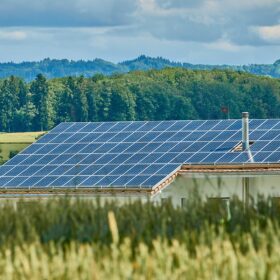
France unveils new FIT rates for PV systems up to 500 kW
France’s new feed-in tariffs (FITs) for the second quarter range from €0.2395 ($0.2653)/kWh for installations below 3 kW in size to €0.1268/kWh for arrays ranging in capacity from 100 kW to 500 kW.
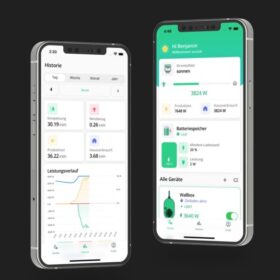
German startup offers app to maximize use of solar power surplus in homes
Clever-PV has developed a manufacturer-independent energy management solution for homes. The app is free to download from app stores and can be connected to PV systems, wall boxes, heat pumps, and other smart devices. This allows users to optimize the use of self-generated solar power.
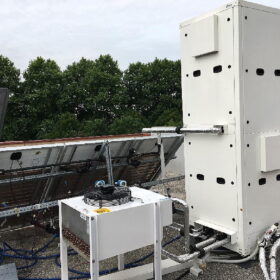
Residential heat pump based on finned coil evaporator, PVT collectors
Scientists in Italy have developed a 5 kW direct-expansion solar-assisted heat pump that uses alternatively two different evaporator technologies. The cooling of the PV module unit by CO2 evaporation increases power production by 8%.
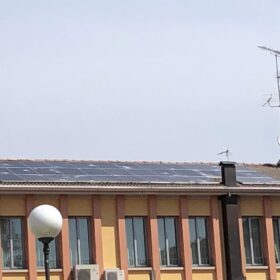
How big must hailstones be to damage PV systems?
The hail storms that occurred recently in northern Italy damaged several photovoltaic systems. pv magazine Italy retrieved a report from the Vrije Universiteit Amsterdam from 2019 which tried to shed light on the damage caused to solar installations by hail by analyzing the effects of a severe hailstorm that occurred in the Netherlands in 2016. According to their assessments, damages to PV modules are mostly derived from hailstones of at least 3 cm in diameter.

To achieve net zero energy status, solar-powered buildings should not exceed 10 floors
Researchers in Canada have found that nearly zero-energy buildings (NZEBs) with on-site solar energy generation should not exceed an energy use intensity (EUI) of 50 kWh/m2a, which they said corresponds to a maximum of 10 floors. They also ascertained that the maximum permitted EUI by net-zero energy status is 17–28 kWh/m2a.
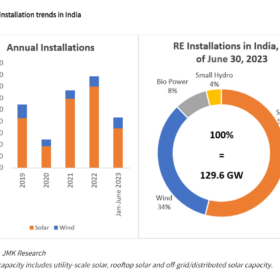
India installed 6.8 GW of solar in H1
India deployed 6.8 GW of solar in the first half of 2023. The rooftop solar segment had 2,294 MW of capacity additions, which is higher than the total rooftop PV installations recorded in 2022.
