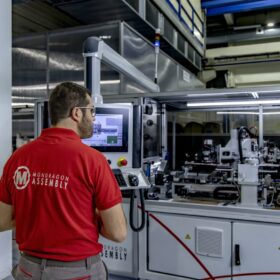
Mondragon Assembly supplies new production line for agrivoltaic modules
Mondragon Assembly has provided French company Reden Solar with a 400 MW production line. Operations are scheduled to start in the first quarter of 2024.

Sri Lankan government launches twin 100 MW floating solar plant tender
The Sri Lankan government’s Ministry of Power and Energy is inviting applicants to submit proposals for the construction of two 100 MW floating solar plants at the hydroelectric Samanalawewa Reservoir. The aim is to complement and “leverage” the country’s third-largest hydroelectric scheme through PV.
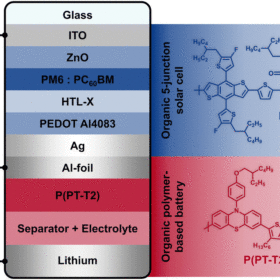
Organic photovoltaic dual-ion battery for Internet of Things applications
Scientists in Germany conceived a solar-powered energy storage system that can reportedly achieve the high voltage levels required for applications in Internet of Things environments. The system combines a multi-junction organic solar cell with a dual-ion organic battery.
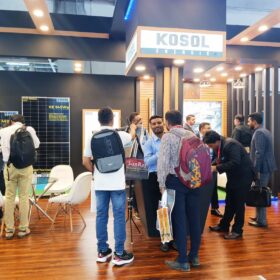
Kosol Energie builds 1 GW of TOPCon solar panel capacity
India’s Kosol Energie has installed a new 1 GW production line to produce TOPCon solar modules ranging from 580 W up to 715 W, in both mono-facial and bifacial variants.
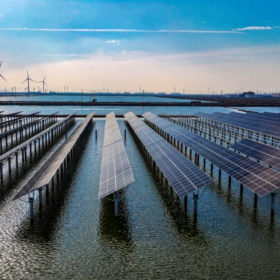
Chinese PV Industry Brief: SPIC commissions 2 GW of aquaculture PV
State Power Investment Corp. (SPIC) built the huge facilities in five phases with the support of PowerChina, an engineering, procurement and construction (EPC) contractor. The project will stretch across occupies a water surface of roughly 44 square kilometers.

Longi claims 33.9% efficiency for perovskite-silicon tandem solar cell
The US Department of Energy’s National Renewable Energy Laboratory (NREL) has confirmed Longi’s achievement of a world record-breaking efficiency rating of 33.9% for a perovskite-silicon tandem solar cell.
German consortium aims for backsheets with 40-year lifecycle
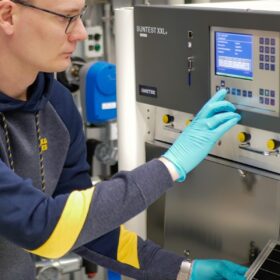
The “Folie40” project involves backsheet makers, solar module manufacturers, and research institutions such as Folienwerk Wolfen, Meyer Burger, Aluminum Féron, Fraunhofer ISE, and the Anhalt University of Applied Sciences.
Chinese institute unveils 26.1%-efficient perovskite PV cell with new additive
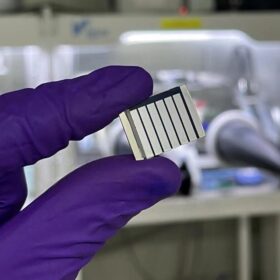
The Chinese Academy of Sciences has unveiled a high-efficiency perovskite solar cell with a purported peak efficiency rating of 26.1%, by using 1-(Phenylsulfonyl)pyrrole (PSP) as an additive. The cell is third-party certified with an efficiency of 25.2%, and it maintains 92% of its original efficiency after 2,500 hours of operation.
Solar cell prices plunge to all-time low
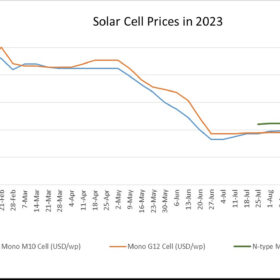
In a new weekly update for pv magazine, OPIS, a Dow Jones company, provides a quick look at the main price trends in the global PV industry.
New attempt to build solar cells based on gallium-arsenide-nitrogen-bismuth
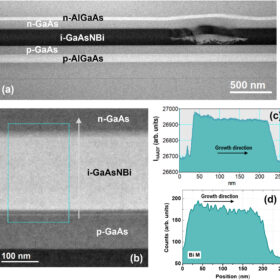
A Finnish-German research group has developed a 6 × 6 mm low bandgap GaAsNBi solar cell with an active area of 0.25 cm2. The device has an energy bandgap of 0.86 eV and is reportedly suitable for applications in multi-junction solar cells.
