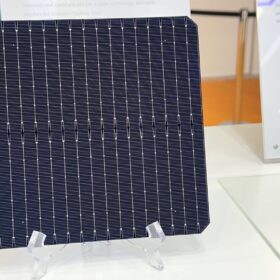
Chinese PV Industry Brief: CNMIA reports flat solar cell, module prices
The China Nonferrous Metals Industry Association (CNMIA) says wafer, cell and module prices remain stable, while industry operating rates are edging lower across leading and integrated manufacturers.

‘Women need to own their path, because growth comes from skills, not labels’
This week Women in Solar+ Europe gives voice to Iualia Meirosu, Group CFO & Board Member at Romania’s Enexus. She says that Romania’s renewable energy sector is no longer just for engineers – it’s a space where women and men can thrive across operations, finance, strategy, and project management.
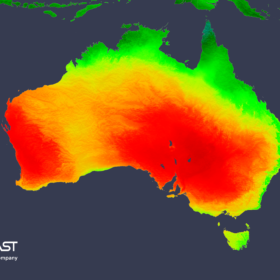
Hot, dry start to 2026 lifts Australian PV, despite fires and monsoon losses
In a new weekly update for pv magazine, Solcast, a DNV company, reports that most of Australia experienced above-average solar irradiance in January 2026 due to a hot, dry airmass and clear skies, boosting PV generation despite operational challenges from elevated temperatures, bushfire smoke, and dust. In contrast, northern Queensland and far northern regions saw significant irradiance deficits from persistent monsoonal clouds and Tropical Cyclone Koji, causing widespread rainfall and localized power outages.
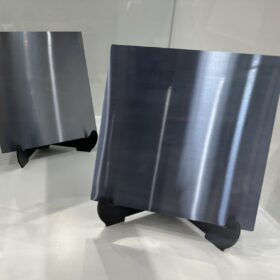
Longi builds 27.25%-efficient back-contact solar cells with high-resistivity wafers
High-resistivity silicon wafers offer superior efficiency potential but are highly sensitive to edge recombination and mechanical damage, limiting their commercial use compared to more robust standard wafers. Researchers from Longi and Sun Yat-sen University demonstrated that integrating in-situ edge passivation unlocks this potential, significantly boosting back-contact solar cell fill factor and efficiency.
Germany awards 2.32 GW in large-scale PV tender
Germany’s latest tender for large-scale PV project concluded with an average final price of €0.0500 ($0.0593)/kWh. The procurement exercise was largely oversubscribed.
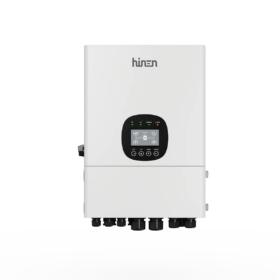
Hinen launches 15 kW three-phase hybrid inverter
The Chinese manufacturer said its 15 kW three-phase low-voltage hybrid inverter is paired with the stackable BP5000 5 kWh battery supporting up to 120 kWh. It features three MPPTs, 150% oversized PV input, and smart load management for optimized self-consumption.
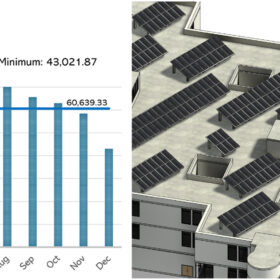
The impact of azimuth angles on PV power production in Saudi Arabia
Researchers in Saudi Arabia conducted a year-long simulation of fixed-tilt PV panels at different azimuth angles, finding that south-facing panels (180°) maximize energy production, while up to 45° eastward shifts cause minimal losses.

Polysilicon transactions remain subdued amid buyer hesitancy
In a new weekly update for pv magazine, OPIS, a Dow Jones company, provides a quick look at the main price trends in the global PV industry.

The impact of land slope on agrivoltaics feasibility
Brazilian scientists have developed a slope-based framework for agrivoltaics, finding that sites below 15% gradient offer the best balance between agricultural suitability and technical feasibility. Their review of 30 studies shows that steeper terrain can host PV systems with adapted designs, land-use limits, erosion risks, and rising installation costs.
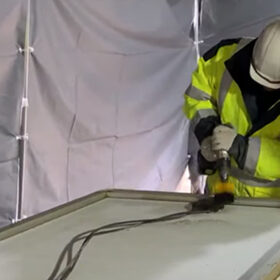
IEC-based technical specifications needed for second-life PV module market
The latest report from the International Energy Agency’s (IEA) Photovoltaic Power Systems Programme (PVPS) says second-life PV modules have the potential to reduce waste and extend the value of solar assets, but their market today remains underdeveloped and requires advances in technical qualifications, scalable reuse infrastructure and supportive policy frameworks.
