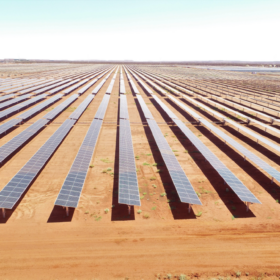
Rooftop solar’s success results in ‘struggling’ large-scale segment in Australia
As rooftop solar racks up records in Australia, price cannibalization has resulted in a “struggling” large-scale market segment. Bruce Mountain, head of the University of Victoria’s Energy Policy Centre, says that increasingly depressed wholesale electricity prices during the day are squeezing out big PV.
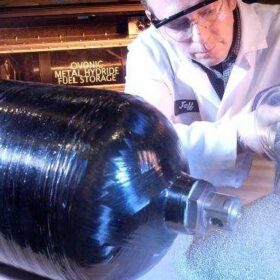
Hydrogen plus battery storage could enable clean energy transition
A new Stanford University report shows that the transition to clean energy could help many countries to reduce their annual energy costs by around 61%.
U.S. publicly traded solar installer Sunworks files for bankruptcy
The residential, commercial, industrial, and agricultural solar installer files for bankruptcy amid troubled macroeconomic conditions for distributed solar nationwide.

Spain’s Genera trade show breaks new records
Spain’s largest renewable energy event saw the participation of the country’s prime minister, Pedro Sánchez, and underscored the excellent state of health of the Spanish PV sector in all its segments.
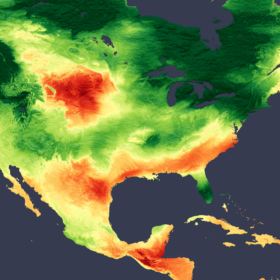
Stormy January impacts irradiance across North America
In a new weekly update for pv magazine, Solcast, a DNV company, reports that North America saw irradiance below average, primarily due to the stormy conditions that prevailed during the second half of January.
Italy allocates 357.2 MW of PV in latest renewables auction
The Italian authorities have allocated 1,001 MW of renewables capacity in the nation’s 13th procurement exercise for clean energy. Developers have offered a maximum discount ranging between 2% and 6.3% from the auction ceiling price of €0.07759 ($0.0818)/kWh.
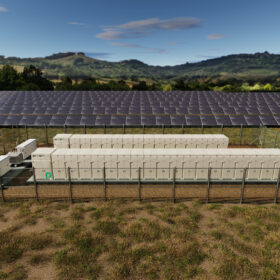
Powin, Galp to install 5 MW/20 MWh of battery storage in Portugal
Galp, a Portuguese energy company, has announced plans to build a 5 MW/20 MWh battery storage system in Portugal, in collaboration with Powin. The system at one of Galp’s solar plants will enable it to adjust its PV production profile and meet its energy requirements. This project marks Powin’s first venture in Europe.
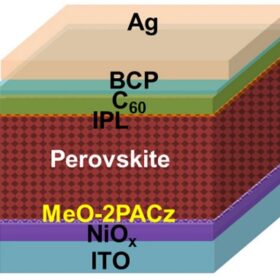
Methylammonium-free inverted perovskite solar cell achieves 23.17% efficiency
Scientists in Japan have fabricated an inverted pervoskite cell with a new bond/charge regulated defect passivation technique consisting of introducing bifunctional molecules onto the perovskite absorber. The device exhibited a low open circuit voltage deficit and remarkable stability.

Optimizing photovoltaic grid integration through active power management
PV systems, surpassing minimum load demands in various regions, necessitate innovative grid integration measures. Active power management (APM), notably curtailment, emerges as a powerful solution here. By actively managing power peaks, PV systems can unlock new possibilities, contribute to grid stability, and enhance their overall value. The new IEA-PVPS Task 14 report encourages a shift in perspective, urging DSOs to explore the potential of APM instead of traditional grid expansion methods.
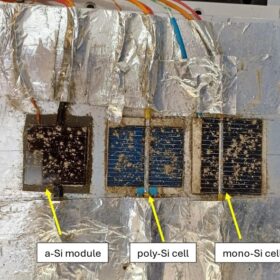
The effect of extreme dust conditions on PV system performance
Scientists in Romania have found that extreme dust conditions may cause losses of 45.35% and 38.14% in maximum power and short-circuit current under outdoor conditions for different kinds of solar modules. They warned that, if the effects of climate change escalate, resulting in less rainfall and more frequent sandstorm events originating from the Saharan region, extreme scenarios are very likely to occur in Europe.
