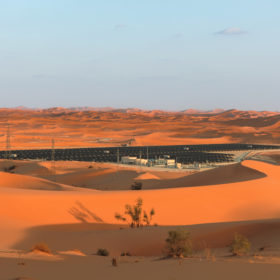
Algeria’s Sonelgaz launches 2 GW solar tender
Algeria’s state-owned utility, Sonelgaz, is seeking proposals to build 15 solar plants in 11 locations. The projects will range in size from 80 MW to 220 MW.
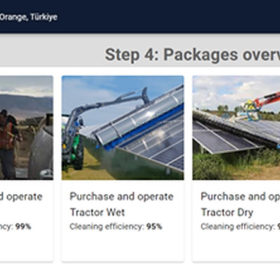
Novel software to optimize PV cleaning strategies
Virtuous-Re’s new PVradar Cleaning App can reportedly model soiling losses and cleaning benefits, while reducing cleaning costs and maximizing the overall economic performance of projects.

Das Solar unveils 22.4%-efficient n-type TOPCon solar panels
Das Solar’s new tunnel oxide passivated contact (TOPCon) product, developed for large-scale PV applications, features 605 W to 625 W of power output. Its temperature coefficient is -0.30% per degree Celsius.
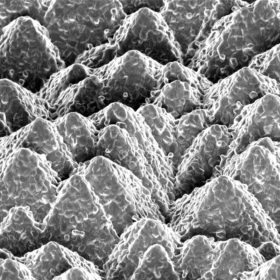
Scratching the surface of silicon in tandem solar cells
German scientists have investigated the role of surface texturing in perovskite-silicon tandem cells and have found that several new processes offer the ability to etch smaller, more uniform textures onto the surface of a silicon cell than today’s industry standard. This could help to ease the subsequent growth of a perovskite cell on top of the silicon, enabling researchers and manufacturers to target higher performance.
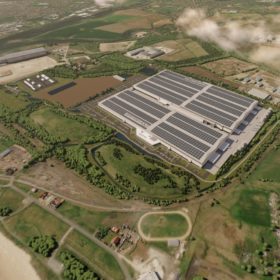
Australian startup buys Britishvolt
Startup Recharge Industries has acquired collapsed battery producer Britishvolt, just weeks after announcing plans to build a lithium-ion battery gigafactory in Australia.

Sono Motors scraps development of Sion solar cars
Sono Motors, a solar electric-vehicle manufacturer in Germany, has terminated its Sion passenger car development program, as it has failed to secure enough funding to support pre-series production. It says it will now focus exclusively on retrofitting and integrating its patented solar technology into third-party vehicles.

Axitec expands solar panel capacity to 2 GW
Module manufacturer Axitec is ramping up its production capacity in China, India and Vietnam to meet growing demand for PV modules in Germany, Austria and Switzerland.
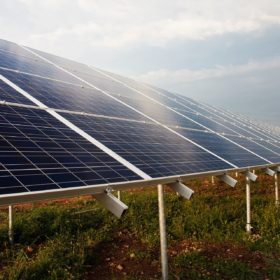
India tenders 1 GW of pumped hydro storage, 200 MW of solar
Karnataka Ltd. has started accepting bids to develop up to 1 GW of pumped hydro storage, while Assam Power Distribution has revealed plans to procure 200 MW of PV capacity.
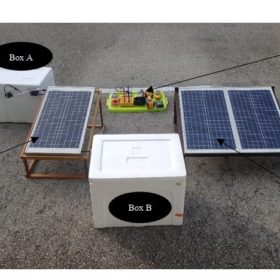
Cooling solar panels with bio-inspired coconut fiber
Malaysian scientists have tested bio-inspired coconut fiber to cool down solar modules. The cooling system features a moist coconut pith encapsulated with a polyurethane sheet. It is placed on the back of a PV module’s surface and acts as a heat sink.
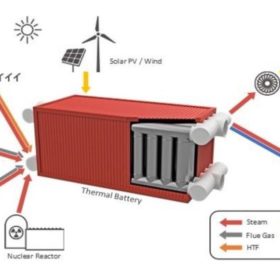
New thermal battery offers fast, efficient performance at low cost
US engineers have built a scalable thermal energy storage prototype system that combines the best latent and sensible heat transfers. The technology, which is now market-ready after three years of testing, consists of engineered cementitious materials and thermosiphons in a combination that enables fast, efficient thermal performance at low cost.
