
The Hydrogen Stream: Norway to make world’s biggest hydrogen ships
Norwegian Ship Design Co. has agreed to help build what it claims will be the two largest hydrogen ships in the world, while Norwegian Hydrogen has announced plans to team up with Australia’s Provaris Energy on hydrogen export opportunities.
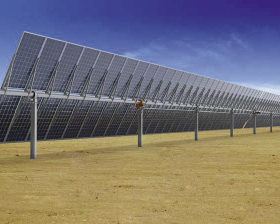
Chinese PV Industry Brief: Arctech to build 3 GW factory in Saudi Arabia
Arctech says it plans to open a 3 GW tracker factory in Saudi Arabia. The tracker manufacturer says the facility in Jeddah will be designed to reach up to 10 GW of capacity.
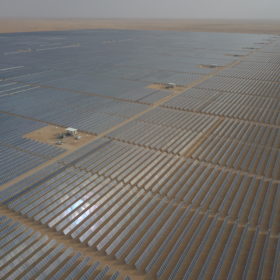
Scientist hails commercial feasibility of Saudi Arabian hydrogen city plan
Alberto Boretti was a senior research professor at Prince Mohammad Bin Fahd University in 2021 when he first started discussing the idea of a hydrogen city in Al Khobar, Saudi Arabia. The New Zealand-based independent tells pv magazine that it is now commercially feasible, as the city’s 200 MW of energy demand would necessitate 1 GW to 1.3 GW of solar and wind capacity, 509 MW to 997 MW of electrolysis capacity, and 145,000 MWh of hydrogen storage capacity.
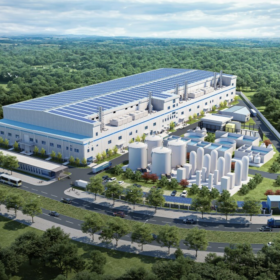
Gstar working on 3 GW silicon wafer factory in Indonesia
Singapore-based Gstar Solar says it has broken ground on a new 3 GW silicon wafer factory in Indonesia, with production scheduled to start by the end of this year.
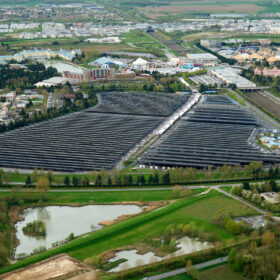
Disneyland Paris completes 36 MW solar carport
Urbasolar has commissioned the last section of a 36.1 MW solar carport at Disneyland Paris. The facility, which covers 20 hectares of parking space, will sell all of the electricity, with no self-consumption.
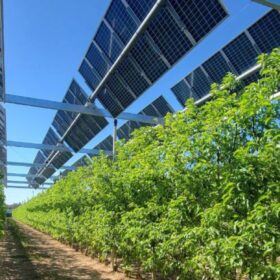
Catalonia sets guidelines for agrivoltaics
The government of the Spanish autonomous region of Catalonia has outlined new requirements to authorize agrivoltaic power generation on agricultural land.

TU Delft presents 21.14%-efficient IBC-HJT solar cell based on molybdenum oxide hole collector
Researchers at the Delft University of Technology have fabricated an interdigitated back contact and heterojunction solar cell that uses a thin full-area molybdenum oxide layer as a blanket layer. The device reportedly ensures well-passivated gaps between electron and hole collecting regions.
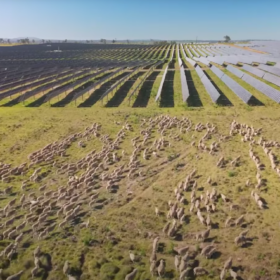
Australian solar farm hosting 6,000 sheep
The first stage of Acen Australia’s planned 720 MW New England Solar Farm in Australia is home to more than 6,000 sheep, which graze beneath the panels in a proof-of-concept agrivoltaics project.

India creates non-tariff barrier for Chinese solar products
The Indian government has reinstated the so-called Approved List of Models and Manufacturers (ALMM) mandate from April 1, 2024. The move creates a non-tariff barrier for Chinese products.

Rapid implementation of NZIA should be used to abolish import tariffs
Tariffs on solar glass harm the European solar industry. This problem can now be easily solved without jeopardizing the European solar glass production.
