
UK government unveils solar roadmap, outlines steps to 47 GW by 2030
The UK government has published its plan to support solar deployment to 2030 and beyond. Policies include updating the Contracts for Difference (CfD) scheme, a safety review of plug-in solar for balconies and rooftops, consulting on car park solar, and engaging with industry on skills and training.
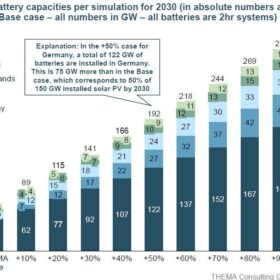
German batteries stabilizing solar energy prices at expense of own profitability
Analyst Thema Consulting Group has calculated the impact of rapid expansion of battery storage systems in Germany and found they will help stabilize solar prices by reducing the number of negatively-priced-electricity hours – but will cannibalize their own revenue in doing so.

Fraunhofer activates Europe’s biggest vanadium flow battery
Fraunhofer Institute for Chemical Technology (ICT) has commissioned Europe’s largest vanadium redox flow battery, a 2 MW/20 MWh pilot facility in Germany.

UAE launches 60 MW solar plant to power gas complex, grid
The emirate of Sharjah has commissioned its first utility-scale solar plant to power the Sajaa Gas Complex and export surplus electricity to the grid. The 60 MWp SANA facility, developed in collaboration with a Masdar–EDF joint venture, is among the first in the region to integrate solar power into oil and gas operations.
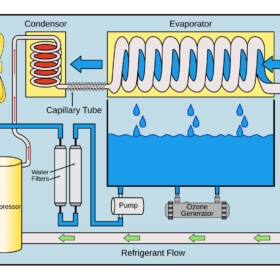
Photovoltaics for atmospheric water harvesting
A scientist in Turkey has simulated eight PV-supported hybrid atmospheric water harvesting systems and compared their performances. They were all considered to operate with R1233zd(E), R1234yf, and R600a, as well as R32 refrigerants. The required PV system size was as low as 20 m2.

Tongwei achieves 91.7% bifaciality factor for 722 W TOPCon solar module
The Chinese manufacturer said the result was confirmed by TÜV Rheinland. It was achieved through a sunken pyramid structure that reportedly achieves selective-texture on the non-electrode area of rear-side and a zebra-crossing passivation contact structure that is said to ensure excellent passivation.

Australian researchers say non-financial barriers limit home battery adoption
A new study from Curtin University in Australia has shown that Australian households are hesitant to adopt home batteries due to significant non-financial barriers, despite growing affordability from government rebates.

US Senate advances bill cutting solar tax credits, adding new levies
The US Senate has advanced a revised reconciliation bill in a 51-49 vote, moving forward with a proposal that eliminates solar tax incentives and imposes new taxes on future clean energy development.

U.S. startup offers tin oxide, nickel oxide materials for flexible perovskite solar cells, modules
Sofab Inks, a spinoff of University of Louisville in the United States, says its transport layer materials enable perovskite solar cells with greater stability, efficiency, and scalability compared to incumbent materials.
