





Scientists from Japan's Institute of Science Tokyo (Science Tokyo) have used supercomputer simulations to unravel the physics of hard carbon (HC) anodes in sodium-ion batteries (NIBs).
HC is a key component in state-of-the-art NIBs, which have gained attention in recent years due to the abundance of sodium. As these batteries near commercialization, researchers have struggled to explain how sodium ions form clusters within HC pores at operational temperatures—and why their overall mobility remains sluggish
“I believe that we are the first group to show the formation of sodium (Na) clusters in hard carbon nano-pores. The diffusion bottleneck for Na ions in hard carbon is also analyzed and visualized at the atomic level for the first time,” corresponding author Che-an Lin told pv magazine. “We showed that Na ions have really high diffusivity in most of the regions in hard carbon, and it's the transition regions between large and narrow graphene interlayer distances that impede Na-ion diffusion. This means that if we can further optimize hard carbon structure, there is a chance to improve its rate capability significantly.”
Lin added that energy density is the most important hurdle scientists need to pass before NIB commercialization can be widespread. “There are some companies that are currently doing or planning mass production for Na-ion batteries and selling Na-ion battery products. Most commercial Na-ion batteries focus on fast charge/discharge and a wide operating temperature range, which are rather challenging for Li-ion batteries. Therefore, as a complementary technology for Li-ion batteries, Na-ion batteries have shown promising performance,” he said.
Yoshitaka Tateyama, who led the research group, further noted in a statement that “ultimately, the widespread adoption of NIBs will increase the overall supply of batteries in society, supporting the realization of a carbon-neutral future. By integrating our new insights, our study provides clearer design guidelines for HC materials capable of storing sodium efficiently, thereby contributing to the development of better NIBs.”
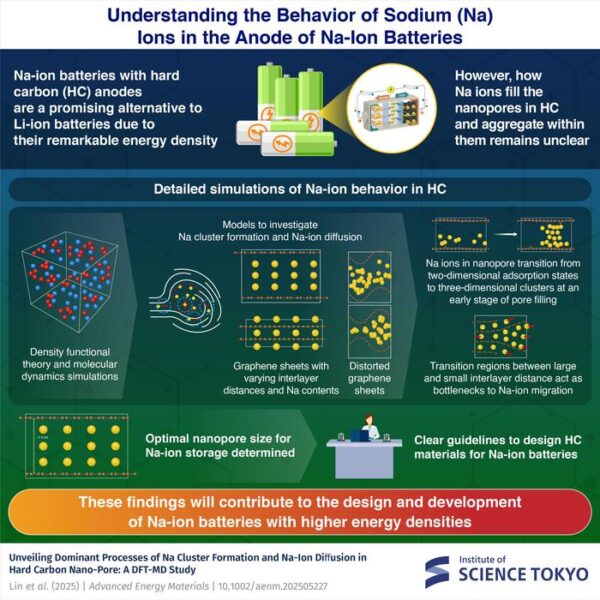
Image: Institute of Science Tokyo
The Tateyama team conducted their research using several high-performance supercomputers, including Fugaku, one of the world’s top ten fastest systems. On those computers, they ran high-accuracy density functionaltheory-based molecular dynamics (DFT-MD) simulations, exploring different arrangements of sodium ions and graphene sheets.
These simulations revealed that sodium ions in nanopores transition early from a two-dimensional adsorptionstate to a three-dimensional, quasi-metallic cluster state. Based on the above finding, the team theoretically determined the optimal nanopore diameter for stable sodium storage, which was approximately 1.5 nm.
“Based on our results, we could provide some guidelines for designing HC anode with high plateau capacity and good cycling kinetics,” the researchers said in the paper. “To obtain high plateau capacity, the pore size and pore fraction should be carefully controlled. We show that the optimal pore size is 1.5 nm, and pore sizes smaller or larger than this can lead to an unstable Na cluster. A small range of pore size distribution with an average pore size of ≈1.5 nm should lead to high plateau capacity.”
Moreover, the simulation study revealed that certain defect-adsorbed sodium ions, rather than acting as nucleation sites, benefit sodium cluster formation by reducing Na-C interactions and the available space for upcoming sodium ions in HC nanopores. In addition, it has been shown that while sodium ions exhibit locally fast diffusion in well-connected areas of HC, branching or reconnection regions act as severe bottlenecks to ion migration. “These narrower transition regions become clogged by sodium ions until enough repulsive force builds up to remove the blockage, creating a rate-limiting step that explains the material's sluggish performance,” they explained.
Their findings were presented in “Unveiling Dominant Processes of Na Cluster Formation and Na-Ion Diffusion in Hard Carbon Nano-Pore: A DFT-MD Study,” published in Advanced Energy Materials.
This content is protected by copyright and may not be reused. If you want to cooperate with us and would like to reuse some of our content, please contact: editors@pv-magazine.com.

By submitting this form you agree to pv magazine using your data for the purposes of publishing your comment.
Your personal data will only be disclosed or otherwise transmitted to third parties for the purposes of spam filtering or if this is necessary for technical maintenance of the website. Any other transfer to third parties will not take place unless this is justified on the basis of applicable data protection regulations or if pv magazine is legally obliged to do so.
You may revoke this consent at any time with effect for the future, in which case your personal data will be deleted immediately. Otherwise, your data will be deleted if pv magazine has processed your request or the purpose of data storage is fulfilled.
Further information on data privacy can be found in our Data Protection Policy.