




From pv magazine Spain
A 440-page report published Friday by an Entso-E expert group has identified systemic failures in voltage control, reactive power management, and regulatory frameworks as the root causes of the blackout that cut power to mainland Spain and Portugal on April 28, 2025. The report distributes responsibility among Spain's grid operator Red Eléctrica, conventional and renewable generation facilities, and the regulatory environment in which they operated.
The report found that key voltage control equipment was connected and disconnected manually, slowing response times, and that operators lacked real-time monitoring of the gap between reactive power required by the system and that actually supplied by generators. Several conventional generators also failed to meet the reactive power set points requested by the system operator, reaching less than 75% of required output at critical moments.
Renewable installations contributed to the cascade. Many operated under fixed power factor schemes, limiting their ability to respond to voltage swings, and a significant number disconnected automatically before reaching the voltage thresholds specified at their grid connection points – some with overvoltage protections set below regulatory limits.
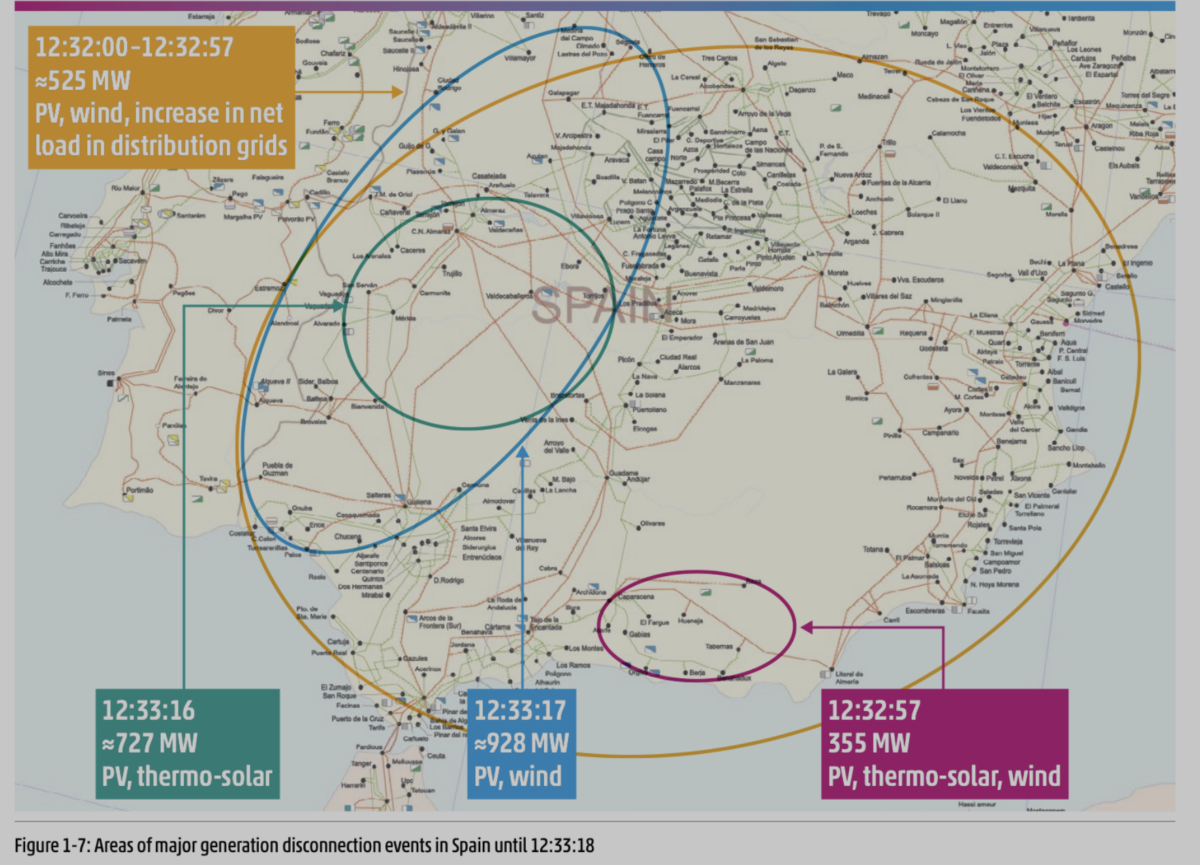
The sequence unfolded rapidly. Between 12:32:00 and 12:32:48 on the day of the blackout, output from large renewable plants – those above 5 MW – in Spain fell by approximately 500 MW. By 12:33:16, disconnections in the Badajoz region had eliminated 727 MW of photovoltaic and concentrated solar power generation. A further 928 MW disconnected across five provinces within the following two seconds. In total, more than 2.5 GW of generation was lost, with voltages exceeding 435 kV. At 12:33:19, the Spanish and Portuguese systems lost synchronism with the European grid. Automatic load shedding and defense mechanisms activated between 12:33:19 and 12:33:22 were unable to prevent the collapse.
ENTSO-E said the investigation was hampered by incomplete data. Distribution system operators (DSOs) did not have access to actual production data from generators below 1 MW – primarily rooftop solar – and several generation unit owners cited a lack of fault records as the reason they could not provide information on disconnections that occurred before the blackout. Two inverter manufacturers provided aggregate data voluntarily; the report notes that data gaps prevented the Expert Group from determining the cause of some disconnections.
The report's 22 recommendations are structured around four areas: voltage control and reactive power, oscillatory stability, disconnection behavior, and defense and restoration. On voltage control, Entso-E calls for sufficient reactive power resources, improved real-time visibility, and a shift away from fixed power factor schemes toward active voltage control. It also recommends harmonizing operating voltage ranges across Europe to 380 kV to 420 kV.
On disconnections, it calls for a review of protection settings and stronger overvoltage ride-through requirements, particularly for small-scale generation. On defense and restoration, it recommends adaptive load shedding schemes and improved coordination among operators. Across all areas, it calls for standardized data collection frameworks to ensure investigators can access complete and consistent records after future incidents.
This content is protected by copyright and may not be reused. If you want to cooperate with us and would like to reuse some of our content, please contact: editors@pv-magazine.com.

By submitting this form you agree to pv magazine using your data for the purposes of publishing your comment.
Your personal data will only be disclosed or otherwise transmitted to third parties for the purposes of spam filtering or if this is necessary for technical maintenance of the website. Any other transfer to third parties will not take place unless this is justified on the basis of applicable data protection regulations or if pv magazine is legally obliged to do so.
You may revoke this consent at any time with effect for the future, in which case your personal data will be deleted immediately. Otherwise, your data will be deleted if pv magazine has processed your request or the purpose of data storage is fulfilled.
Further information on data privacy can be found in our Data Protection Policy.