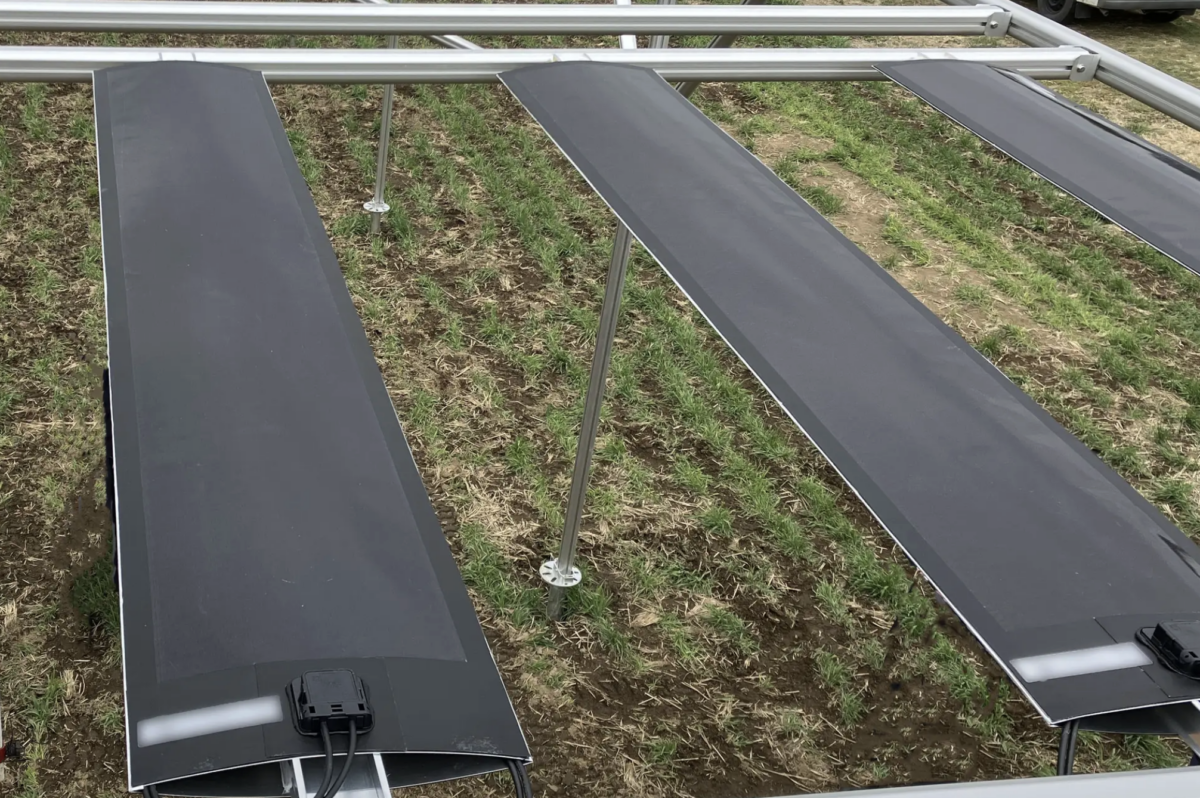





A consortium of Japanese partners are working on a pilot project that has installed an agrivoltaic installation made of film-type perovskite solar cells over rice paddy fields.
The five collaborators, Sekisui Solar Film, Terra Inc, Himawari Green Energy, Chiba University and Chiba Bank, entered a memorandum of understanding to deploy the installation at the university’s Kashiwa-no-ha campus, located around half an hour north of the capital, Tokyo, in Japan’s Chiba prefecture.
Under the terms of the agreement, Sekisui Solar Film provides the film-type perovskite solar cells, Terra is responsible for the construction, operation and maintenance of the installation and Himawari Green Energy will conduct a business feasibility assessment of an agricultural management model that utilizes perovskite solar cells. Chiba University provides the fields and will be assessing the installation’s impact on agricultural work and crops, while Chiba Bank is providing financial support.
The project, set to last three years, will verify the performance of the lens-type perovskite modules in the rice paddy fields, as well as the installation's impact on the agricultural land, the yield and quality of rice crops and impact on methane emissions. Chiba University will also purchase the electricity generated by the installation.
This latest collaboration follows work between Terra and Sekisui Chemical Co, parent company of Sekisui Solar Film, which have been working on verification tests on lens-type modules using film-type perovskite solar cells in Sōsa City since August 2024.
Last May, Sekisui Solar Film announced work collaborating on flexible perovskite solar module technologies with the Netherlands Organization for Applied Scientific Research (NTO). The company is also working on a 100 MW perovskite solar production line in Japan, targeted for operations in 2027.
Earlier this month, the Japanese government began to develop new standards for agrivoltaics which will require developers to submit cultivation plans, financial projections, equipment designs and evidence that crops can grow beneath panels. It follows a voluntary reference guide from the Japan Photovoltaic Energy Association that features land-sharing approaches to agricultural installations.
Previous research has pointed towards agrivoltaics on rice paddies, including a recently-concluded field trial, involving trade‑offs between crop yields and energy output.
Last month, Japanese petroleum company Idemitsu Kosan announced its 2 MW agricultural solar power plant, installed 3.8 meters above a rice paddy, is now operational. The project features a community-based model that returns a portion of the profits from power generation to the farmers.
This content is protected by copyright and may not be reused. If you want to cooperate with us and would like to reuse some of our content, please contact: editors@pv-magazine.com.


By submitting this form you agree to pv magazine using your data for the purposes of publishing your comment.
Your personal data will only be disclosed or otherwise transmitted to third parties for the purposes of spam filtering or if this is necessary for technical maintenance of the website. Any other transfer to third parties will not take place unless this is justified on the basis of applicable data protection regulations or if pv magazine is legally obliged to do so.
You may revoke this consent at any time with effect for the future, in which case your personal data will be deleted immediately. Otherwise, your data will be deleted if pv magazine has processed your request or the purpose of data storage is fulfilled.
Further information on data privacy can be found in our Data Protection Policy.