





Lithuania’s solar capacity reached 3,040 MW by the end of 2025, according to a report from the International Energy Agency's Photovoltaic Power Systems Programme (IEA-PVPS).
According to data available in IEA-PVPS’ Country Updates 2025, the country’s cumulative solar capacity stood at approximately 2.4 GW by the end of last year, indicating around 600 MW were added last year.
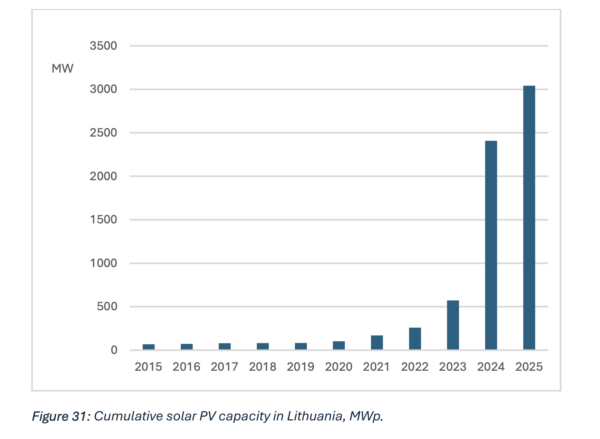
Image: IEA-PVPS Country Updates 2025
Additional figures from the report state that solar power plants in Lithuania generated 1.79 TWh of electricity in 2025, accounting for 14.2% of total national electricity consumption. This equates to 1,053 kW per capita, which places Lithuania among the best performing in this metric of all EU member states.
The report says the main driver in Lithuania’s solar market has been a consistent and forward-looking state policy implemented by the country’s Ministry of Energy. Market growth has been driven primarily by solar prosumers, of which there are around 170,000 in Lithuania that covered around 70% of total solar electricity production in 2025.
These prosumers have benefited from a net-metering scheme that originally set no capacity limits for households or companies. Commercial companies have now transitioned to a net-billing system but net-metering is still applied to households and non-profit entities, although all new solar producers are expected to operate under net-billing in the near future.
Households and small- to medium-sized enterprises have also benefitted from public investment support schemes, typically covering up to 30% of installation costs. Larger-scale solar has also been growing in Lithuania, with the country’s largest operational project to date standing at 100 MW. Among the largest projects under developments are two 91 MW sites belonging to Vilnius-based renewable energy company Green Genius.
While growth is expected to continue, with technical permits already issued for an additional 4 GW of solar, Juras Ulbikas, research director at the Applied Research Institute for Prospective Technologies and contributor to the IEA-PVPS report, told pv magazine he believes the market is reaching saturation due to a lack of grid capacity.
“Solar and wind are already covering 68.1% of electricity demand,” Ulbikas explained. “This number already exceeds Lithuania’s strategy targets for electricity from renewable energy sources, which was aligned with grid development measures.”
Ulbikas shared that prosumers are also facing problems acquiring technical permits for solar installations. “It means that further solar market growth will be strongly dependent on other technologies which can complement solar generation without pressure on the local grid,” he said, before adding that he expects solar market growth to align with developments in the storage market in the next years.
Nearly 2 GW of battery energy storage system (BESS) facilities were awarded technical permits in 2025. Lithuania announced an 800 MWh energy storage tender in February 2025 which ended up procuring 1.7 GW/4 GWh of capacity following overwhelming interest.
Ulbikas told pv magazine Lithuania already has support schemes for both hybrid solar-plus-storage farms and standalone BESS. “Another measure coming through is issuing technical permits for large scale solar plants if it shares the same grid connection point with wind plants, as this mitigates the intermittent nature of renewable energy generation,” he also explained.
IEA-PVPS’ report adds that the integration of thermal energy storage is also increasing, beginning with the deployment of heat storage systems using phase-change materials in combination with heat pumps, particularly in households.
Lithuania’s National Energy Independence Strategy has set a target of 100% electricity from renewables by 2030. The strategy was adopted in 2024, ahead of the country’s synchronization to the continental European electricity network, along with its neighbours Estonia and Latvia, in February last year.
This content is protected by copyright and may not be reused. If you want to cooperate with us and would like to reuse some of our content, please contact: editors@pv-magazine.com.


By submitting this form you agree to pv magazine using your data for the purposes of publishing your comment.
Your personal data will only be disclosed or otherwise transmitted to third parties for the purposes of spam filtering or if this is necessary for technical maintenance of the website. Any other transfer to third parties will not take place unless this is justified on the basis of applicable data protection regulations or if pv magazine is legally obliged to do so.
You may revoke this consent at any time with effect for the future, in which case your personal data will be deleted immediately. Otherwise, your data will be deleted if pv magazine has processed your request or the purpose of data storage is fulfilled.
Further information on data privacy can be found in our Data Protection Policy.