




Researchers from the University of Exeter in the United Kingdom have evaluated the deployment of floating PV (FPV) on Hong Kong's water reservoirs.
The team has simulated two distinct cases. In one, FPV powers households' demand while also producing and storing hydrogen, which is converted back to electricity at night when solar generation is unavailable. In the second case, hydrogen production via electrolysis is used solely to fuel the city's transportation system.
“This work outlines a clear pathway for Hong Kong, where land availability is limited, and building rooftops remain the primary option for photovoltaic deployment,” corresponding author Aritra Ghosh told pv magazine. “In this context, the utilization of 18 existing reservoirs for floating PV systems has the potential to generate a substantial share of electricity, which could significantly contribute to residential electrification across Hong Kong.”
Ghosh said that according to the team's findings, “at 60% coverage, the FPV systems generate approximately 4.8 TWh of electricity annually, while 100% coverage yields about 7.72 TWh per year. When coupled with hydrogen storage, the FPV system at full coverage could supply electricity to approximately 490,000 households.”
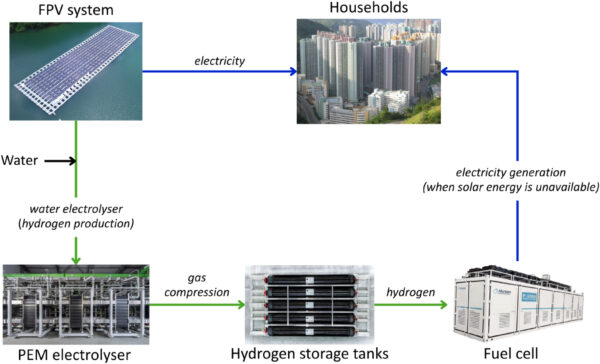
Image: University of Exeter, International Journal of Hydrogen Energy, CC BY 4.0
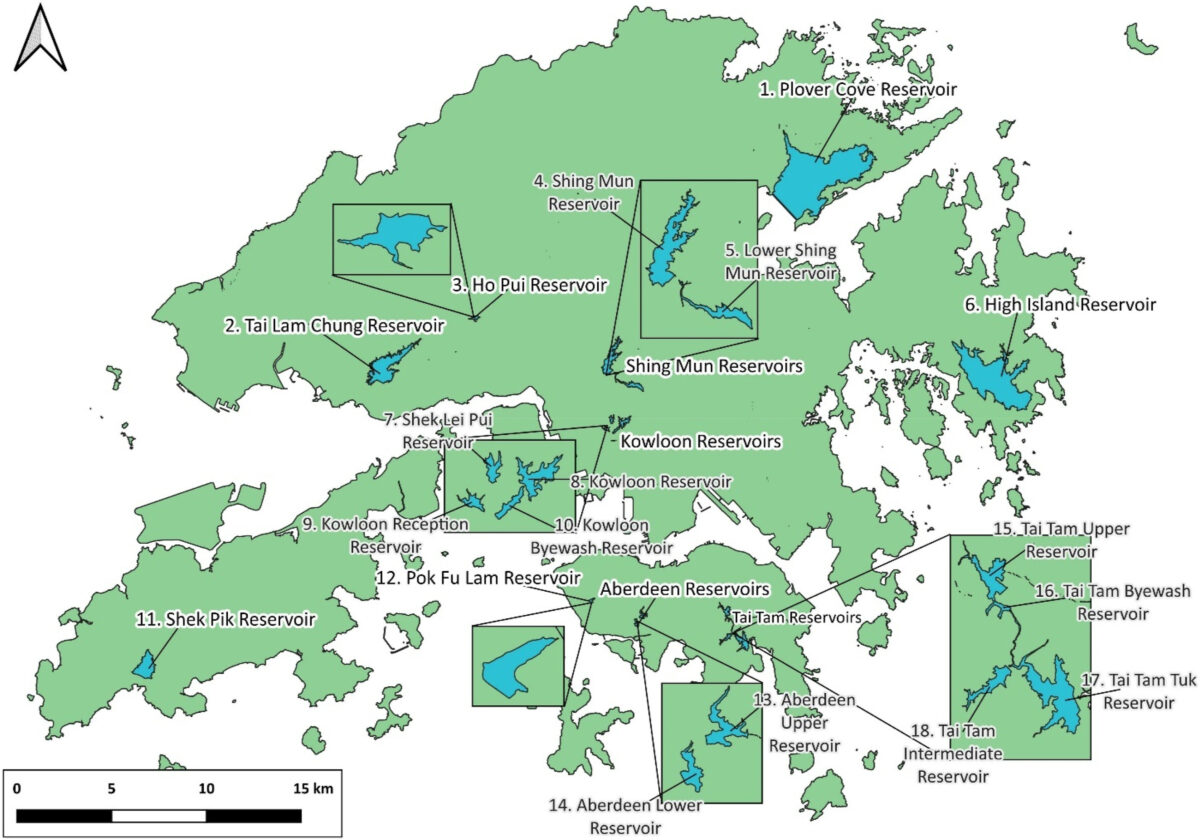
To achieve those results, Ghosh's team began by identifying reservoirs in Hong Kong. To that end, they have used files downloaded from the Planning Department for spatial analysis. They excluded most irrigation reservoirs from the study because they were too small for an FPV installation. Only the Ho Pui irrigation reservoir was considered, given its larger size, along with 17 impounding reservoirs. Seven reservoirs are located on Hong Kong Island, one on Lantau Island, and the remaining ten are situated in Kowloon and the New Territories.
Using PVsyst and HOMER Pro, the group has considered crystalline silicon PV modules with a power rating of 350 W and an efficiency of 19.2%. Each measures 1775 mm × 1038 mm × 30 mm, with an area of 1.82 m2. Each module had an open-circuit voltage of 40.1 V, a short-circuit current of 11.15 A, and a bifaciality of around 70%. The operating temperature ranged from –40 C to 85 C.
With a theoretical 100% coverage, the total annual energy production from all 18 reservoirs is 7.72 TWh, of which the Plover Cove Reservoir accounts for 49.5%. Covering all of those reservoirs was found to supply 17.2% of the city's annual electricity demand in 2022, and 61% of the residential sector demand. At 60% coverage, the total effective yearly energy generated by the PV arrays is 4.8 TWh, with Plover Cove Reservoir producing nearly half of this, at 2.37 GWh per year. Under 60% coverage, 36.5% of residential electricity consumption could be covered.
The group has further focused on the potential implementation of 60% FPV coverage, as it has been found to optimize power production, reduce algal growth and water evaporation, and minimize negative impacts on the aquatic ecosystem. Two cases were tested, namely household power and hydrogen refuelling for the transport sector.
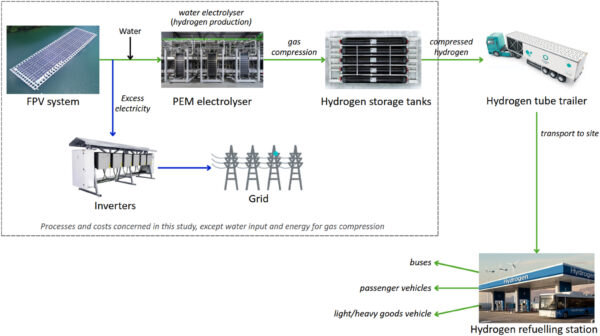
Image: University of Exeter, International Journal of Hydrogen Energy, CC BY 4.0
In the first case, the FPV directly powers households' demand. At the same time, a portion is diverted to the electrolyser for hydrogen production, which is then stored as compressed gas in the hydrogen tank. At night and during periods of low solar production, fuel cells use hydrogen to generate electricity, which is then supplied to households. The efficiencies used are 75.8% for the electrolyser and 60% for the fuel cell. For fueling the transport sector, different hydrogen demand profiles were tested, ranging from 500 kg to 100,000 kg per day at the largest reservoir.
“Results show annual hydrogen output ranging from 180,502 kg to 36,310,221 kg, depending on reservoir size, with associated levelized cost of hydrogen (LCOH) between $10.2/kg and $19.4/kg,” the scientists said. “The hydrogen produced could support ongoing hydrogen bus projects and future expansion to other vehicle types as Hong Kong moves toward a hydrogen-based transport system. After coupling FPV systems with hydrogen-generation units, the new levlized cost of electricity (LCOE) ranges from $0.029–4.01/kWh. Thus, suggesting the feasibility of a hydrogen-integrated FPV system in Hong Kong.”
According to the research team, the FPV systems alone produced an LCOE of $0.037/kWh and all sites achieve a high performance ratio (PR) of approximately 88%. Meeting Hong Kong's 2035 target of 1-2% of solar energy in its fuel mix, the results further revealed, would require covering only 6-12% of reservoir surfaces.
The research work appeared in “Analysis of floating photovoltaics potential in Hong Kong: Green hydrogen production and energy application,” published in the International Journal of Hydrogen Energy.
This content is protected by copyright and may not be reused. If you want to cooperate with us and would like to reuse some of our content, please contact: editors@pv-magazine.com.

By submitting this form you agree to pv magazine using your data for the purposes of publishing your comment.
Your personal data will only be disclosed or otherwise transmitted to third parties for the purposes of spam filtering or if this is necessary for technical maintenance of the website. Any other transfer to third parties will not take place unless this is justified on the basis of applicable data protection regulations or if pv magazine is legally obliged to do so.
You may revoke this consent at any time with effect for the future, in which case your personal data will be deleted immediately. Otherwise, your data will be deleted if pv magazine has processed your request or the purpose of data storage is fulfilled.
Further information on data privacy can be found in our Data Protection Policy.