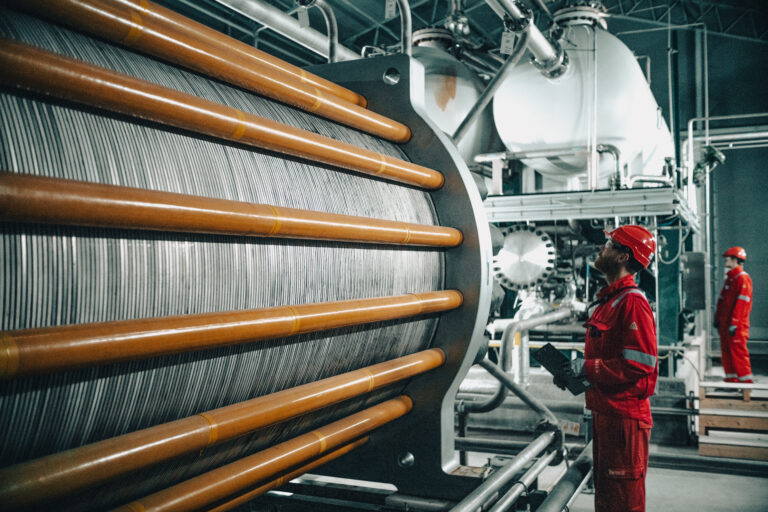





HydrogenPro said that the 220 MW ACES project in Utah, United States, is nearing completion. HydrogenPro is the exclusive supplier of electrolyzers. “This project is one of the world's largest renewable hydrogen projects and is expected to have a significant impact on California's power supply,” said the Norwegian company, adding that all 40 electrolyzers across all units have been operating at full load. The Advanced Clean Energy Storage Hub (ACES Delta) is being jointly developed by Chevron New Energies Company and Mitsubishi Power to produce and store up to 100 tons of green hydrogen per day. Hydrogen will be stored in two salt caverns, each with an energy capacity of 150 gigawatt-hours (GWh), to be fed back into the grid when needed. “The Energy Hub has a storage capacity two to three times greater than all grid-connected battery storage facilities in the entire United States combined,” said HydrogenPro.
Jena researchers have collaborated with the Institute of Inorganic Chemistry I at Ulm University to develop a material that can store solar energy for several days and release it as hydrogen. “You can think of it as a combination of a solar cell and a battery at the molecular level,” said Sven Rau, who heads the German institute. The researchers used a water-soluble, redox-active copolymer for temporary energy or electron storage. Copolymers are macromolecules composed of different organic building blocks, forming a stable framework equipped with functional units with reinforced redox activity. The system achieves a charging efficiency of over 80% and maintains this state for several days. By adding an acid and a hydrogen evolution catalyst, stored electrons combine with protons to produce hydrogen on demand, with an efficiency of 72%.
Karlsruhe Institute of Technology (KIT) researchers have set a new runtime record with a compressorless hydrogen gas turbine. The burner, featuring pressure-gain combustion technology, operated for 303 seconds, surpassing NASA’s previous record of 250 seconds. “This achievement sets new standards for the use of hydrogen in energy supply,” KIT said, adding that earlier this year, the team successfully generated electricity with a hydrogen gas turbine without a mechanical compressor for the first time.
Germany's Federal Transport Ministry (BMV) has presented funding certificates to transport companies across the country, including Ruhrbahn, which will receive a grant of around €11.6 million($13.7 million) to procure 52 modern fuel cell buses. “Hydrogen offers long ranges, short refueling times, and great operational flexibility, especially in densely networked regions,” said Managing Director Ahmet Avsar, commenting on the impact in Germany’s Ruhr region. Since 2025, 19 hydrogen-powered public buses have been in service in the Ruhrbahn operating area, with a further seven expected by the end of 2026.
This content is protected by copyright and may not be reused. If you want to cooperate with us and would like to reuse some of our content, please contact: editors@pv-magazine.com.

By submitting this form you agree to pv magazine using your data for the purposes of publishing your comment.
Your personal data will only be disclosed or otherwise transmitted to third parties for the purposes of spam filtering or if this is necessary for technical maintenance of the website. Any other transfer to third parties will not take place unless this is justified on the basis of applicable data protection regulations or if pv magazine is legally obliged to do so.
You may revoke this consent at any time with effect for the future, in which case your personal data will be deleted immediately. Otherwise, your data will be deleted if pv magazine has processed your request or the purpose of data storage is fulfilled.
Further information on data privacy can be found in our Data Protection Policy.