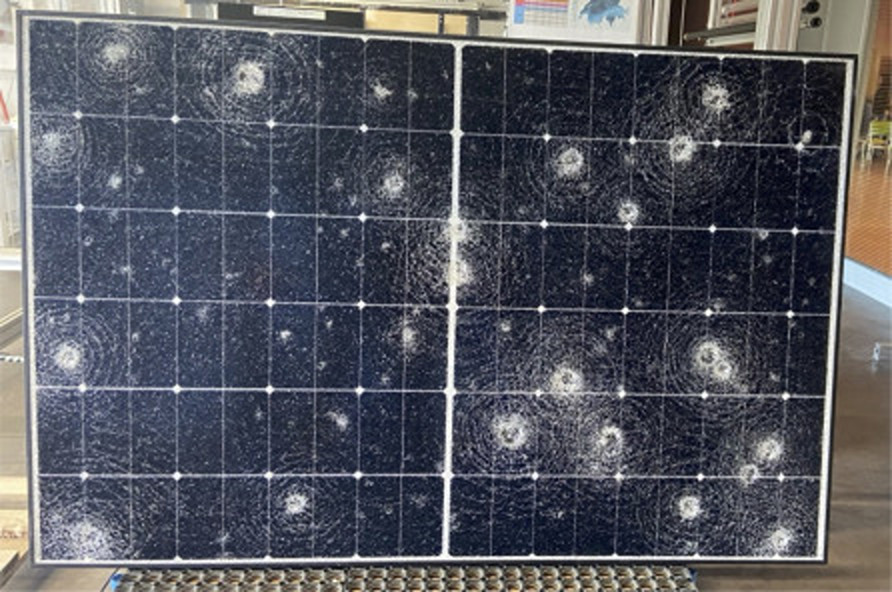





Severe convective storms accounted for at least 47% of global insured catastrophe losses in 2025, generating $60 billion in total losses, according to Gallagher Re's recently published “Improving Underwriting for Renewable Assets” report.
SCS and hail have accounted for more than $200 billion, or 42%, of all insured losses in the United States since 2020, compared with 34% from hurricanes. The United States was hit by at least 13 billion-dollar insured SCS loss events in 2025 alone, making it the third-costliest SCS year on record for insurers, behind 2023 and 2024.
“Hail has emerged as a key driver of losses for solar PV, particularly in regions exposed to severe convective storms,” said Tina Baacke, head of Germany and Austria at Swiss Re Corporate Solutions. “Latest Swiss Re research shows that 2025 was the third-costliest year on record for SCS – including hailstorms and damaging winds, after 2023 and 2024 (in 2025 prices) – adding $51 billion of insured losses globally. At the same time, other perils such as fire remain a key concern, with the potential to cause total losses if not effectively managed. This underlines the importance of robust safety concepts, including clear emergency response procedures and coordination with local fire services, to reduce the risk of high-severity events. At Swiss Re Corporate Solutions, we are placing great emphasis on site-specific hazard assessment, asset design and operational resilience when evaluating PV projects.”
Claims data
AXIS Capital's analysis of closed solar claims between 2019 and 2025 found that hail accounted for 27% of natural catastrophe and extreme weather losses globally by total claim amount. More than 1 million PV modules have been damaged since 2019, accumulating a total gross claim of $342 million. The trend is being driven in part by module technology shifts: claims involving heat-strengthened glass PV modules – now widely adopted for weight and cost reductions – are $50,000/MW higher on average than claims involving fully tempered thicker glass, according to AXIS Capital data.
Sophie Draper, risk engineer for renewable energy at AXIS Capital, said increased claims activity reflects rapid solar expansion into geographies not historically associated with hail risk, where local convective weather patterns are less well understood. She said that as more projects come online globally, the growing area of glass panels is providing deeper data on hail impacts, and that AXIS Capital is monitoring scientific evidence suggesting climate change is contributing to stronger convective storms capable of generating larger hailstones.
Reflecting that uncertainty, Edward Gillespie, senior underwriter for renewable energy at AXIS Capital, said the company calibrates capacity deployment to known and unknown exposure.
“In areas we know to be highly exposed to hail or where the level of exposure is unknown, we must be prudent about the amount of capacity we deploy,” Gillespie told pv magazine. “Our aim is to deliver solutions for clients while maintaining underwriting discipline. We put a high focus on reviewing a project from the outset including how it's been designed, constructed, and operated as well as a client's approach to managing risk. It is important to see that clients are placing equal importance on each of these areas to properly mitigate these risks. Projects that demonstrate excellence may unlock more capacity while clients with projects in highly exposed areas may offset higher pricing and capacity limitations if their overall portfolio is well diversified, containing low and high risk-exposed projects.”
Mitigation gap
AXIS Capital sees this dynamic in South Africa, where new solar projects are increasingly located in the country's more hail-prone eastern and northeastern regions – where energy demand and grid capacity are highest.
Tim Topham, underwriter for renewable energy at AXIS Capital, said the trend is compounding underwriting risk.
“Combined with the growing size of these projects, it creates an increased underwriting risk, and we need to take this into account when considering the terms we can provide, including limits and line sizes,” said Topham.
On mitigation, Draper said the three pillars AXIS Capital considers critical are accurate real-time forecasting, appropriate technology including trackers capable of stowing to more than 60 degrees, and a well-informed operations strategy. North American developers have broadly adopted these measures, she said, but uptake is lagging in markets with shorter operating track records, where hail probability models are warning of exposure.
AXIS Capital claims analysis found that the average cost of a PV hail claim is roughly halved when panels successfully stow, compared with claims where no stow occurred or the stow failed. Modeling by Nextracker and RETC found that for 2.0 mm front glass at 20 miles per hour front wind, breakage probability could be reduced 83% by moving from a 30-degree to a 75-degree stow angle.
Hail losses at utility-scale solar facilities have drawn increasing attention in the US market. A Texas solar project cut its insurance costs by 72% through targeted hail mitigation measures, while a separate analysis showed that hail risk exposure is increasingly affecting project finance terms. In April 2025, VDE Americas and kWh Analytics launched a new tool to help developers quantify site-specific solar hail exposure before financial close.
This content is protected by copyright and may not be reused. If you want to cooperate with us and would like to reuse some of our content, please contact: editors@pv-magazine.com.

No you really should stay out of the business if how much capacity is deployed and just do your job, which is to sell insurance with a balance between some corporate profits. But what corporations have forgotten and maybe never cared, is the American public. So forgive me if I take exception to an insurance guy trying to slam solar while petroleum accelerates the most destructive attack on this planet.