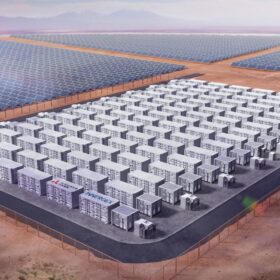
Chile releases bidding terms for 5,400 GWh renewables, storage auction
The Chilean authorities want to contract 5,400 GWh of power from renewable energy, while also including battery storage. The selected developers will secure 20-year power purchase agreements (PPAs).
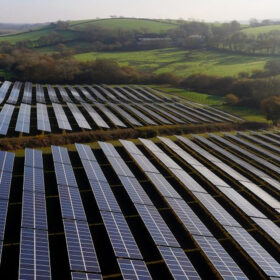
DIF secures 10-year PPA for 55 MW of solar, 40 MW/80 MWh of storage
DIF Capital Partners has secured a 10-year power purchase agreement (PPA) for a solar-plus-storage project in Bedfordshire, England. It includes 55 MW of solar capacity and 40 MW/80 MWh of storage, making it the first large-scale solar-plus-storage PPA in the country.
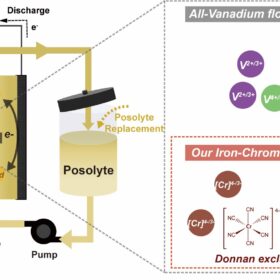
Iron-chromium redox flow battery with high energy density
Researchers led by Korea’s UNIST developed a new redox flow battery concept that utilizes iron and chromium ore for redox chemistry. The proposed battery configuration may reportedly achieve a stable lifetime of 500 cycles, and a high-energy density of 38.6 Wh L−1.
Strategies to convert PV into a dispatchable source using minimum storage
Scientists in Australia have provided a comprehensive review of all strategies and technologies that can be used to increase the dispatchability of solar power with reduced use of storage. They focused their efforts, in particular, on forecasting and controlling PV power.
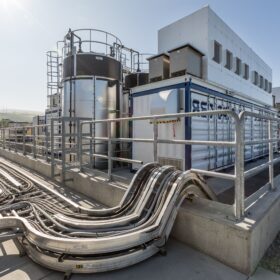
Sumitomo reveals testing results of redox flow battery project in California
Sumitomo says that its 2MW/8MWh vanadium redox flow battery achieved a 99% operating rate at San Diego Gas & Electric’s (SDG&E) facility in California. The battery is expected to retain a capacity rate of 90% or more for 20 years in the electricity market.
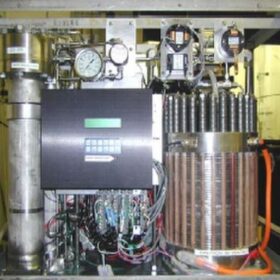
India launches tender for 1.5 GW of electrolyzer production
Solar Energy Corp. of India (SECI) has launched a tender to set up 1.5 GW of electrolyzer manufacturing capacity in India under the government’s incentives scheme.
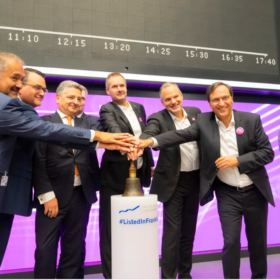
The Hydrogen Stream: Thyssenkrupp lists hydrogen business in Frankfurt
German engineering conglomerate thyssenkrupp has listed shares of its hydrogen business, thyssenkrupp nucera, on the Frankfurt Stock Exchange (Prime Standard).
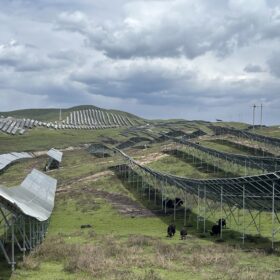
Chinese oil company switches on high-altitude 40 MW solar-plus-storage plant
China National Offshore Oil Corp. (CNOOC) says it has completed a 40 MW solar-plus-storage plant at an altitude of 3,000 meters. It is connected to 6 MW/12 MWh of battery storage and hosts grazing farm animals.

Hithium closes $622 million funding round
Hithium, a Chinese manufacturer of lithium-ion stationary energy storage systems, has announced a Series C funding round consisting of more than CNY 4.5 billion ($622 million). It will primarily use the funds to expand production capacity, procure advanced equipment, and conduct R&D.
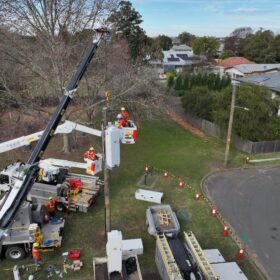
Australian grid operator adopts pole-mounted storage tech
Ausgrid has installed its first pole-mounted battery energy storage system as part of a trial to more effectively manage growing penetration of rooftop solar and periods of peak demand.
