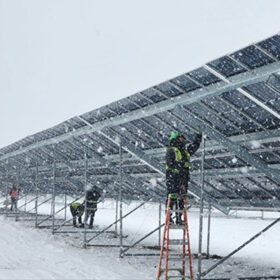
The frost heave challenge in solar installations
A Terrasmart Innovation Engineer looks at ways of overcoming weather challenges particular to the installing solar in Midwest states.

Taiwan launches $126 million rebate program for small rooftop PV
Taiwan’s Ministry of Economic Affairs (MoEA) says it will offer up to TWD 300,000 ($9,260) per project through a $126 million rebate program for small rooftop PV systems, with eligibility limited to systems not exceeding 3 kW.
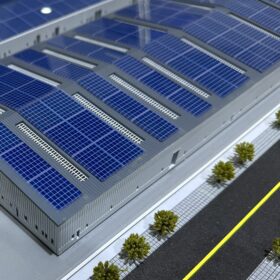
China issues new rules to support peer-to-peer energy trading
China’s National Energy Administration (NEA) has introduced a new set of measures to support peer-to-peer energy trading. The new initiatives are expected to remove barriers for the further development of distributed PV projects.
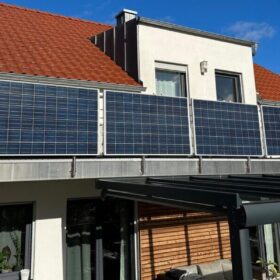
German startup offers refurbished solar modules in balcony PV systems
Germany’s Panelretter is now offering German customers plug-in solar devices that use refurbished second-life solar modules. There are three different models with output ranging from 400 W to 810 W. The prices for the complete sets start at €220 ($232).

Northern Europe takes the brunt of first winter systems
In a new weekly update for pv magazine, Solcast, a DNV company, reports that European solar generation displayed a sharp north-south divide in November. Southern Europe benefited from a stabilizing high-pressure system that deflected much of the Atlantic’s moisture-laden air masses northward.
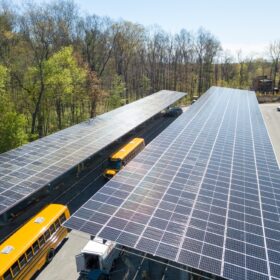
US targets 50 GW of solar in 2024
The United States is expected to grow its solar fleet by more than 25% from 2023 levels, with over 8 GW of distributed solar and more than 40 GW of utility-scale solar expected to be installed.

Ten reasons why small-scale, non-utility solar is important
Behind-the-meter solar for homes, businesses, and communities comes with numerous benefits, said a paper from Stanford engineering professor Mark Jacobson.

Germany could deploy 10 million heat pumps by 2030
Scientists have used open-source models to simulate heat pump rollout scenarios for the year 2030. Additional investments of around 54 GW to 57 GW of solar PV capacity in a least-cost solution would allow the installation of 10 million heat pumps by the end of the decade.
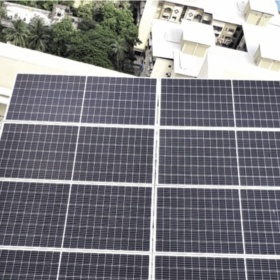
Gujarat leads India with 46% of rooftop PV installations under subsidy scheme
The state of Gujarat leads India in residential rooftop solar adoption, accounting for 46% of the 616,019 systems installed nationwide under the PM-Surya Ghar: Muft Bijli Yojana initiative as of Nov. 21, 2024.

ADB commissions 500 kW solar project with 2 MWh of storage in Tuvalu
The Asian Development Bank (ADB) has commissioned a 500 kW solar rooftop project in Tuvalu’s capital, Funafuti, along with a 2 MWh battery energy storage system (BESS).
