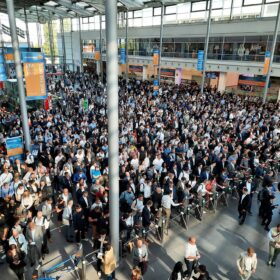
Intersolar 2024: Day 3: Tecloman unveils Cubox mobile storage platform
Our pv magazine newshounds will be walking the floors for one last time in Munich today as Intersolar Europe 2024 winds down for another year.

Crop-responsive PV tracking system for greenhouses
An international consortium led by Israel-based Al-Zahrawi Society announced the first European installations of a multi-year project to test crop-responsive PV systems combined with carbon dioxide enrichment in greenhouses.
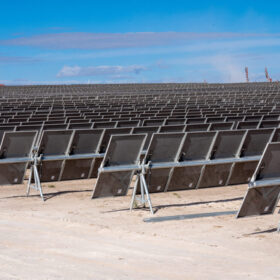
Nextracker acquires solar foundation specialist Ojjo for $119 million
Ojjo makes a unique truss system that reportedly uses half the steel of a conventional foundation and a design that minimizes grading requirements.
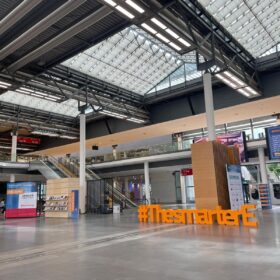
Intersolar Liveblog 2024: Ban-Ki Moon, Cate Blanchett at ‘We Choose Earth Tour’
Our pv magazine newshounds are walking the floors in Munich today to bring you all the developments at Intersolar Europe 2024.
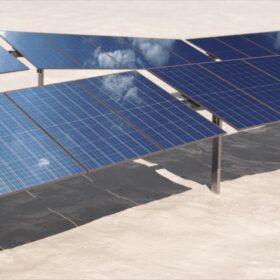
Axial launches new dual-row tracker AxialTracker SlopeSync
The new tracker incorporates cardan joint technology along its main axis of rotation, which allows each section of torque tube to have a different inclination or slope while maintaining the continuity of the rotation and rotation of the PV modules.
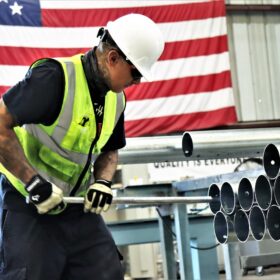
Nextracker expands U.S. manufacturing with Unimacts
Owned by Unimacts and located near Las Vegas, the factory will produce steel components exclusively for Nextracker, bringing the tracker specialist’s annual domestic solar tracker capacity to over 30 GW.

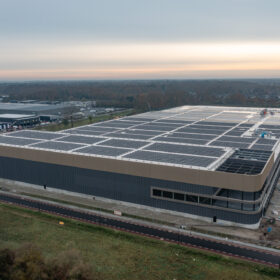
CPX and PanelClaw announce brand merge
The two companies will continue operations under the name PanelClaw, as they set out ambition to support commercial and industrial rooftop customers in both the United States and Europe, then eventually worldwide.

U.S. startup claims doubled energy per acre with terrain-following solar array
California startup Planted Solar uses construction robots and high-density arrays to deliver what the company says are higher energy outputs and lower balance of system costs.
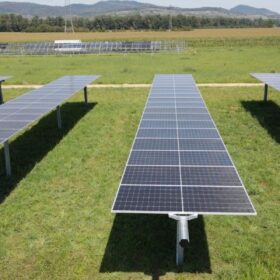
Digital twin technologies for solar tracking in agrivoltaics
Fraunhofer ISE researchers are applying deep learning and digital twin modelling tools to optimize PV tracker control systems for use in farming and biodiversity projects. The goal is to be able to automatically position the modules throughout the day to meet the needs of the plants growing below, in light of the microclimatic conditions, and the need to optimize yield.
