
US solar makers accuse Toyo and Origin Solar of duty evasion in Ethiopia
Eight US solar manufacturers have filed an anti-circumvention complaint with the US Department of Commerce, alleging that solar cells and modules assembled in Ethiopia using Chinese-origin components are evading existing antidumping and countervailing duty orders on Chinese solar products.

ARTsolar challenges local content compliance in South African solar tenders
A High Court in South Africa ordered the country’s Ministry of Mineral Resources and Energy to deliver full documentation relating to three solar tenders awarded in 2021 and 2022 to local solar manufacturer ARTsolar, after the company questioned if the preferred bidders had followed local content requirements for PV modules set out in the tenders. ARTsolar told pv magazine its legal team is currently reviewing the documentation it has received.
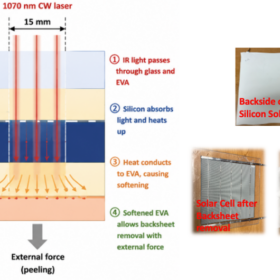
Continuous-wave infrared laser technology enables damage-free backsheet removal in end-of-life solar modules
U.S. researchers have developed an IR-CW laser-based method to remove backsheets from end-of-life silicon solar modules without damaging the glass or wafers, using controlled heating of the silicon–EVA interface through the front glass. The process enables clean mechanical delamination with preserved device performance and offers a lower-energy, lower-cost alternative to conventional thermal or chemical recycling methods.

Solar Impulse 2 crashes in Gulf of Mexico during unmanned test flight
The aircraft, acquired by Skydweller Aero in 2019 and converted into an autonomous long-endurance platform, crashed after a loss of power. It was equipped with approximately 17,000 photovoltaic cells on its wings.

Jolywood starts mass production of low-silver TOPCon solar cells
The Chinese manufacturer said its novel TOPCon cell design enables partial replacement of silver with aluminum paste while maintaining TOPCon-level efficiency of over 27% and compatibility with existing production lines.
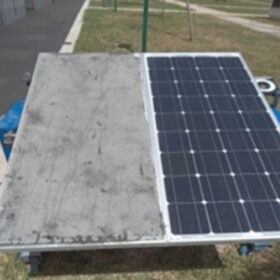
The impact of fly ash-induced soiling on PV panel performance
Scientists in Morocco have conceived an experimental–numerical model to quantify how fly ash soiling affects photovoltaic (PV) modules, capturing both optical losses and thermal effects. Their findings show that while dust layers can reduce panel temperature, fly ash significantly degrades efficiency in a non-linear way, highlighting the need for predictive models for real-world solar performance.
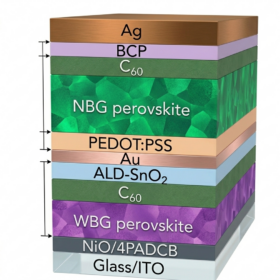
All-perovskite tandem solar cell built with laser polishing achieves 29.80% efficiency
Chinese researchers developed an all-perovskite tandem solar cell using a non-contact laser polishing strategy that reduces surface defects and improves charge extraction in lead-tin perovskite films. The device achieved up to 29.80% tandem efficiency, with the bottom cell improving from 19.64% to 24.07% and showing strong operational stability under continuous illumination.

Coal India shuts down solar manufacturing arm
The Indian coal company has dissolved its solar manufacturing subsidiary, CIL Solar PV Ltd, formally ending its planned entry into integrated solar PV manufacturing.

Hybrid tidal-photovoltaic system for modular renewables deployment in estuarine channels
Researchers in Brazil have developed and simulated a hybrid tidal–PV floating farm concept for estuarine channels, analyzing wake effects, turbine spacing and hybrid energy trade-offs. Results show that integrating PV with hydrokinetic turbines improves overall energy yield by offsetting wake-related losses and optimizing modular farm configurations.
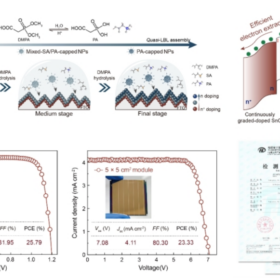
Chinese researchers achieve world-record efficiency of 27.17% for inverted perovskite solar cell
The proposed inverted perovskite solar cell design reduces band misalignment and electron accumulation, suppressing recombination losses and enabling high efficiency in both small-area devices and scalable modules.
