
UtmoLight pushes perovksite PV module efficiency to 18.1%
UtmoLight has reached 18.1% efficiency with its perovskite PV modules, according to results confirmed by the US National Renewable Energy Laboratory (NREL).

US solar facilities lost $5,720 per MW to equipment issues in 2024
US solar facilities lost $5,720 per megawatt in 2024, with global losses from equipment failures and extreme weather reaching $10 billion. Raptor Maps says 193 GW of projects recorded rising power losses, primarily from inverters, strings, and combiners, with regional weather risks varying significantly.

Trina, Daidohant launch new load-bearing mounting solution for heavy snowfall
The Chinese manufacturer has collaborated with Japan’s Daidohant on the new product. It reportedly suppresses deformation with a special bar attached to the back of the solar module.

Tandem PV moves toward perovskite manufacturing with $50 million funding
With a perovskite layer 200 times thinner than silicon and requiring just 10% of the energy needed to produce conventional panels, Tandem PV reports it will be able to reduce energy use during manufacturing.

Chinese scientists build 20.3%-efficient mini inverted perovskite solar modules via slot die coating
A team led by University of Electronic Science and Technology of China (UESTC) has found that pyrrodiazole as an additive in formamidinium iodide (FAI)-based inverted perovskite solar enables larger area devices made with industry-compatible slot die coating. Modules made using the technology achieved 20.3% certified power conversion efficiency and retained 94% of initial efficiency after 1,000 h in standard testing.

Chinese PV Industry Brief: Solar glass prices on the rise
Solar glass prices continued to climb this week, with 2.0 mm sheets rising 8% to CNY 13.5 ($1.85) per square meter and 3.2 mm sheets up 9.8% to CNY 22.5, according to the China Nonferrous Metals Industry Association (CNMIA).

Grid Parity unveils new glass-glass module for agrivoltaic systems
The translucent 320 W solar module will be presented for the first time in Rimini, Italy. It will be produced by production partner Agora in Slovakia from the third quarter.

New technique to predict solar inverter temperature
An international research team has developed a novel approach for predicting inverter temperature through symbolic regression based on particle swarm optimization.
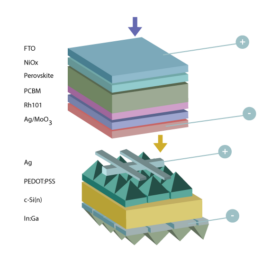
Indian scientists build 4T perovskite-silicon tandem cell based on hybrid heterojunction PV device
A research group in India has embedded a hybrid heterojunction solar cell as a bottom device in a four-terminal perovskite-silicon solar cell using a solution processing technique. The novel cell architecture, according to its creators, could be produced at significantly lower costs compared to conventional perovskite-silicon tandem designs.
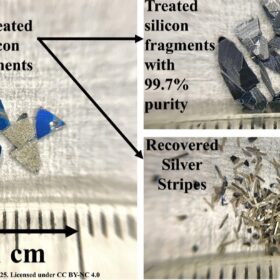
UNSW develops PV panel recycling method that recovers cell metals for upcycling
UNSW researchers were able to recover silicon from end of life solar PV panels pure enough for re-use in silicon carbide-based devices. Their novel multi-step method which includes thermal and chemical processes, also recovers silver.
