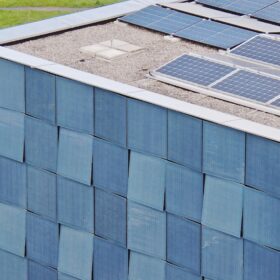
Screen-printed colored glass BIPV modules with sequins-like effect
Swiss retailer Lehner Versand generates 24.5% of its building energy needs thanks to a renovation project that added 109 kW capacity of solar PV to its facade. The PV array has a sequins-like effect, enabled by screen-printed glass modules and a novel curtain wall sub-structure.
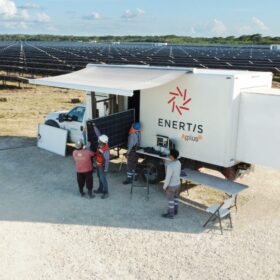
Lab on wheels for on-site solar module testing
Spain-based energy specialist Enertis Applus has introduced a new mobile solar module testing lab to the wider Australian market, following extensive trials at solar farms in New South Wales and Queensland.
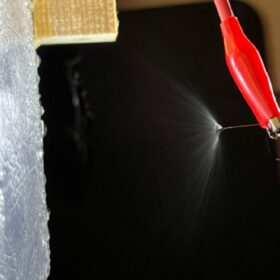
Reducing solar module temperature via electrospray cooling
Scientists in Turkey have sought to use electrospray cooling to reduce the operating temperature of photovoltaic for the first time. They said their experiments offer promising results for the potential application of this technique in real PV systems.

Onyx Solar launches walkable PV tiles
The Spanish building integrated PV manufacturer has launched glass-glass modules suitable for rooftops and other urban spaces. The new products have a nominal capacity of 75 W.

Solar cell based on silver bismuth sulfide exceeds 10% efficiency threshold for first time
This kind of solar cell technology had so far reached efficiencies of up to 9%. The new result was made possible by a post-deposition in situ passivation strategy to reduce surface defects in the device, according to its creators.
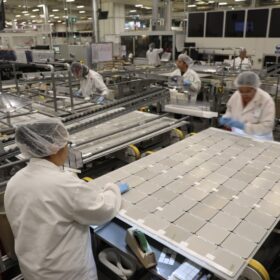
Maxeon Solar pivots business to focus exclusively on U.S. market
The solar panel manufacturer announced a five-year lease of a factory in Albuquerque, New Mexico.

Chinese PV Industry Brief: PowerChina launches 300 MW offshore PV project
PowerChina has unveiled plans for a 300 MW offshore PV pilot project in the Bohai Sea, using advanced solar panels designed to endure extreme marine conditions.
Inverted perovskite solar cell based on co-absorbed self-assembled monolayer achieves 24.68% efficiency
A research team in China improved the efficiency and stability of an inverted perovskite cell using a co-adsorbed approach to incorporate self-assembled monolayers at the hole transport layer.
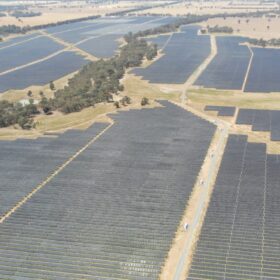
Fotowatio Renewable Ventures turns on 300 MW of solar in Australia
Fotowatio Renewable Ventures (FRV) says its 300 MW Walla Walla Solar Farm in New South Wales, one of the Australian state’s largest solar projects, has started generating power. The milestone comes less than two years after FRV Australia reached financial close on the development.

Scientists create PV-driven synaptic device for AI processing
A team from Tokyo University of Science has developed a solar cell-based computing device that mimics human synaptic behaviour to use in edge AI processing. The researchers say the device has the potential to accelerate the development of energy-efficient edge AI sensors in applications including health monitoring, surveillance and automotive technologies.
