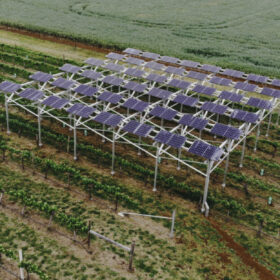
Australian university testing 20 kW agrivoltaic system on vineyard
Australian renewables company Greenwood has installed 48 solar panels at the University of Melbourne’s Dookie Campus vineyard to aid research on how agrivoltaics affect crop yields.

Shift to 2 kV voltage in solar projects tipped to gain traction
Amid record-low prices for solar modules, the focus of cost reduction for utility-scale solar projects is shifting to non-module balance-of-system (BoS) expenses. A transition from 1.5 kV voltage to 2 kV in solar projects is expected to gain traction through 2030.

ESMC publishes recommendations for restoring Europe’s solar industry
The European Solar Manufacturing Council’s (ESMC) working group has issued a recommendation paper praising the Net-Zero Industry Act (NZIA), but says clearer and stronger support is needed for European solar production.

China approves polysilicon futures
The China Securities Regulatory Commission (CSRC) has approved polysilicon derivatives to address rising price volatility and structural imbalances between supply and demand in the solar-grade polysilicon market.
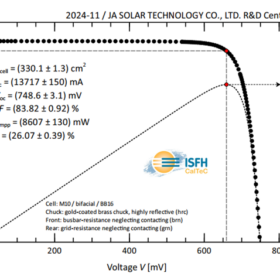
JA Solar claims world record open-circuit voltage for TOPCon solar cell
The Chinese manufacturer said its Bycium+ PV cell achieved an open-circuit voltage of 748.6 mV. The result was confirmed by Germany’s Institute for Solar Energy Research in Hamelin.

Japanese startup developing flexible chalcopyrite solar modules
PXP Corporation has recently secured JPY 1.5 billion ($9.98 million) in a round led by Japan’s Softbank Corp. to move forward with its plan to build a 25 MW chalcopyrite module factory.

Indian state allots land for solar manufacturing projects
The Indian state of Madhya Pradesh has received solar manufacturing proposals from Grew Energy, Insolation Green Energy, Premier Energies Global, Saatvik Solar and other companies. Land allotment letters for these industrial units were recently given away by the state’s chief minister.

Trump touts solar trade tariffs
While the US Inflation Reduction Act (IRA) is reshoring solar manufacturing in the United States, raising import tariffs may slow momentum. The actions of the incoming Trump administration are tough to forecast at this point.

Solar trade headwinds
Prices across the solar supply chain remained in bearish territory into the fourth quarter of 2024. Trade and regulatory developments have continued to preoccupy the industry and dampen trading activity.
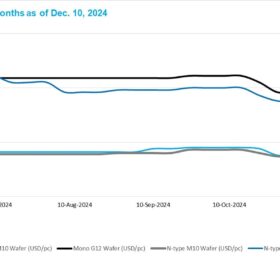
Solar wafer prices stabilize as supply rationalizes, regional policies shape production and trade
In a new weekly update for pv magazine, OPIS, a Dow Jones company, provides a quick look at the main price trends in the global PV industry.
