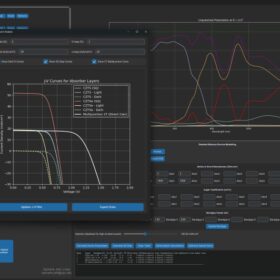
New open-access simulation software for solar cell modeling
Developed by a professor at the Polytechnic University of Catalonia, the Soley software is claimed to enable precise optoelectronic modeling of photovoltaic devices and accurately reproduce the behavior of photodiodes under illumination.
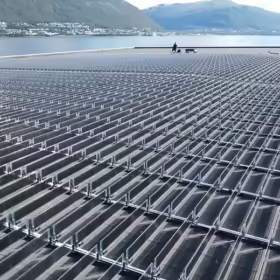
World’s largest vertical rooftop solar installation deployed in Norway
Vertical solar specialist Over Easy Solar has broke its own record for the world’s largest rooftop vertical solar array with a 320 kW system in the north Norwegian city of Tromsø.
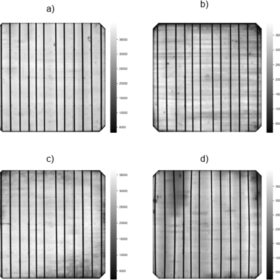
Copper-metalized heterojunction solar cells close to achieve same efficiency as silver-based counterparts
Researchers in Germany have shown that heterojunction solar cells screen printed with silver-copper on the front side and silver paste on the rear side can achieve a 0.13% efficiency gain over reference screen-printed bifacial cells based on silver alone. The research group worked specifically on dispensing and screen printing as printing methods.

Swiss startup offers timber-framed solar carport
Urbanpv has developed a timber-framed 46 kW parking lot design for ten parking spaces including the access lane.

Enhancing dual-axis solar tracker performance with new optimization techniques
Researchers in India have developed two solar tracker optimization techniques can purportedly increase power generation by up to 54.36% when combined. One uses a light sensor and the other relies on data from GPS and a real-time clock.
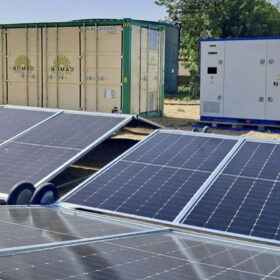
Spanish startup offers portable solar-plus-storage generators for irrigation
Spanish startup Nomad Solar Energy and Full&fast have deployed a portable solar-plus-storage system at a Madrid farm to provide off-grid power for irrigation.

Gautam Solar unveils 630 W TOPCon module for utility-scale solar projects
Gautam Solar has introduced 630 W R-Series tunnel oxide passivated contact (TOPCon) modules for utility-scale PV projects, approved under India’s Approved List of Models and Manufacturers (ALMM) and Bureau of Indian Standards (BIS).

Korean scientists achieve 21% efficiency in polycrystalline solar cell for underwater environments
The cell was fabricated with a 2.3 nm-thin layer of gallium oxide, a silver busbar aimed at improving charge collection and silicon nitride anti-reflection coating. It was encapsulated within a watertight 3D-printed box to ensure impermeability.

‘Preaching to the unconverted’ – EUPVSEC 2025 kicks off in Bilbao
The annual European Photovoltaic Solar Energy Conference (EU PVSEC) got underway today, this year in Bilbao. Conversations on the first morning focused on the need for strong policy support across multiple areas of renewable energy. While the week is sure to be filled with new ideas on the technological side, it’s clear that ensuring policies to support further growth in renewable energy is a growing challenge. Those working in the solar industry and research community need to reach a wider audience, and one that may not be as easy to convince.

Optimum tilt angle for PV systems ranging from 0° to 90°
A Slovak research team has developed a mathematical model for determining the optimum tilt angle of a solar system ranging from 0° to 90°. Their framework was tested on an experimental setup in Czechia and attained 93.9% accuracy in predicting the system’s energy balance.
