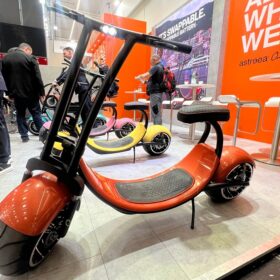
Cow poop (and more) on the floor at Intersolar
Cow dung battery binder, a beautiful electric moped, parking lot level car charging, big rig charging, and “balcony solar” energy storage on the floor at Europe’s largest solar power show.

FuturaSun, TNO sign bifacial solar cell collaboration
FuturaSun and The Netherlands Organization for Applied Scientific Research will work together on advancing the design of bifacial n-type silicon solar cells, with the technology to be integrated into FuturaSun’s Silk Nova solar modules.

TCL SunPower launches back contact solar modules
The SunPower M Class product portfolio offers solar panels for the residential and commercial markets featuring the company’s latest back contact solar technology. The panels are expected to reach 25% efficiency for residential applications up to 500 W and 24.4% for commercial applications up to 660 W.
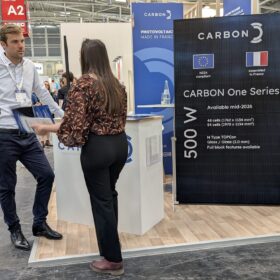
Carbon unveils first PV panels
At the Intersolar trade show in Munich, the startup Carbon is showcasing its first PV modules, which will be available from mid-2026 in power ranges from 445 Wp to 505 Wp. A third module, with power outputs from 615 Wp to 625 Wp, will later complete the Carbon One series.
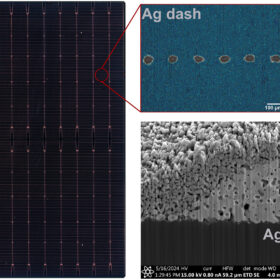
Silver-lean screen-printing can reduce silver use in TOPCon solar cells by 40%
An international research team has developed a metallization technique for TOPCon solar cells that can reportedly reduce silver usage in the devices’ rear side by 85%. The scientists replaced the commonly used Ag fingers with intermittent Ag dashes for contact formation and Ag-free fingers and busbars for electrical conduction.
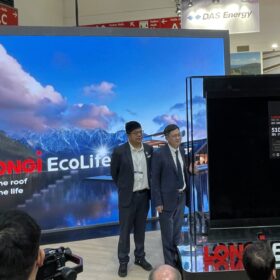
Longi launches all-black back contact solar panel series
The EcoLife series brings Longi’s back contact technology to the residential solar market with panels that reportedly offer quicker system payback and reduced power degradation over time.
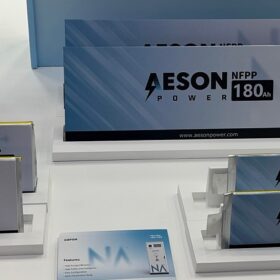
Breakdancing on the floor at Intersolar
Europe’s largest solar power event now fills 18 very large rooms at the Munich trade show. Intersolar predicts greater than 200,000 visitors will see the almost 5,000 unique exhibitors showing off their hardware and services.
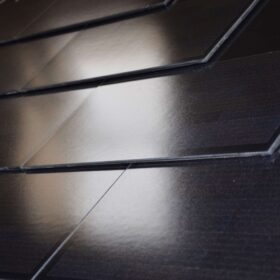
Fraunhofer ISE and Freesuns launch PV roof tile pilot line
The flexible, automated production allows Swiss project partner Freesuns to produce its newly developed matrix shingle roof tiles on a pilot scale before moving into mass production.

Longi launches residential heterojunction back-contact solar module with 25% efficiency
Longi has developed the Hi-MO S10, a residential heterojunction (HJT) back-contact solar module with 25% efficiency, combining 27.6%-efficient cells with up to 510 W output and 252.3 W/m² power density.
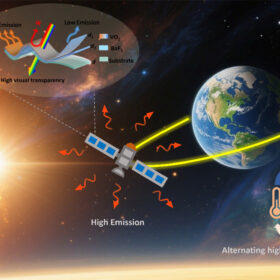
Novel smart coating for space solar cells
Researchers in China have investigated how transparent smart radiation devices (TSRD) can be used to protect space solar cells from extreme thermal fluctuations. Through a series of simulations, they have shown that the proposed technique could become an “effective” solution for spacecraft solar cell thermal management.
