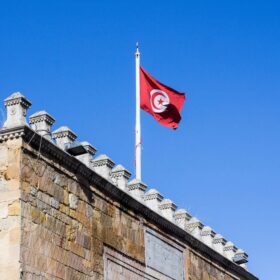
Tunisia launches 200 MW solar tender
Tunisia’s Ministry of Industry, Mines and Energy has kicked off a new procurement exercise for large-scale solar.

Indonesia’s installed solar capacity surpasses 700 MW
The Institute for Essential Services Reform says Indonesia’s solar industry has faced a downturn over the past two years, but policy reforms should accelerate solar deployment in the coming years. The think tank’s latest report states that 16.92 GW of projects are currently in the pipeline across the country.

‘Beyond keeping the lights on, solar builds community resilience’
This week, Women in Solar Europe (WiSEu) gives voice to Nataliia Cherepovska, communication manager at Poland’s Menlo Electric. She says that especially in Ukraine, where she comes from, solar is more than a green initiative – it’s a lifeline. “Solar-powered crucial facilities keep running even when the grid falters, ensuring critical services,” she states. “Solar energy doesn’t just power buildings – it powers hope, security, and progress.”
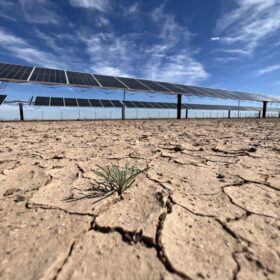
California farmers developing 20 GW solar-plus-storage plan
The Golden State recently signed AB 2661, granting the Westland Water District authority to develop transmission lines that will enable solar energy and storage projects on 130,000 acres of drainage-impaired farmland.
Grid defection is profitable in some solar-rich U.S. locations
Researchers from Canada’s Western University assessed eighteen case studies across thirteen US states and found in areas an economic case for disconnecting from the electricity grid in some areas with high solar irradiation and high electricity rates. They say economic grid defection and utility death spirals are becoming salient issues in the US.

Hungary expected to surpass 300,000 residential solar installations
Hungary’s Ministry of Energy says it will support more than 25,000 households with residential solar installations through its subsidy scheme, which launched earlier this year, taking the total number of installations to in excess of 300,000.
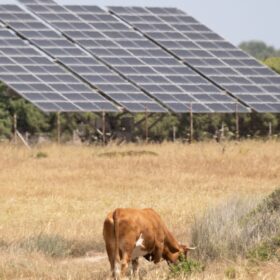
SolarPower Europe calls for EU nature-inclusive solar policy
A policy paper by SolarPower Europe and the Nature Conservancy says clear policies are needed at the EU level to define, incentivize and scale up nature-inclusive solar projects.
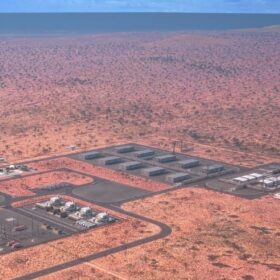
South Australia earmarks regions for large-scale renewables
South Australia has announced two proposed release areas designated for the development of large-scale renewable energy projects in the Whyalla and Gawler Ranges regions.
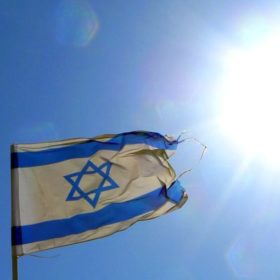
Can Israeli PV tenders preserve competition in a concentrated market?
Researchers have studied Israel’s clearing price method for PV tenders and raised concerns about its potential for long-term dominance. They examined how power abuse and technological inefficiencies lead to market inefficiencies, concluding that a duopoly best suits the Israeli market.

Italy preps energy storage auctions
The appropriate minister has signed into law a decree which will allow electricity transmission system operator (TSO) Terna to stage procurement exercises, possibly as early as the first half of 2025.
