
Determining mismatch losses in bifacial PV based on single-axis trackers
Scientists in Spain have proposed a novel way to calculate the structure shading factor and mismatch losses for the rear side of bifacial PV modules using one-axis trackers. They tested the new methodology in a real PV system and found it is able to establish a linear fit based on distance from the torque tube.
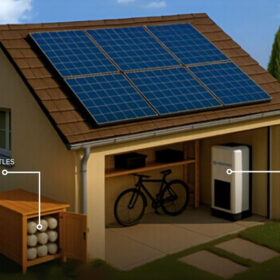
Segula presents compressed air storage system for residential applications
The system consists of a reversible compressor connected to a storage unit that can be installed indoors or outdoors. The compressor must be connected to the solar panels, with the whole system being controlled by an application that optimizes self-consumption.

FuturaSun releases 390 W silver solar panel
The Italian manufacturer said the new version of its silver module is ideal for grey roofs and buildings with modern architecture. It uses a 3.2 mm silver-coated glass and features a power conversion efficiency of 19.52%.
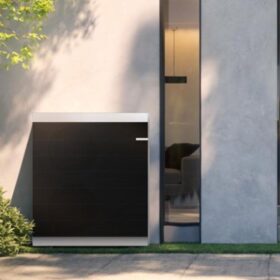
Amitime unveils residential propane heat pump
The Chinese manufacturer said its new heat pump system can continuously and stably provide hot water up to 75 C. At a temperature between 35 C and 55 C, the new product can reportedly achieve a seasonal coefficient of performance (SCOP) of 4.6 to 5.23, with COP values ranging from 3.86 to 5.63.

Korean researchers achieve world record efficiency of 23.64% for flexible perovskite-CIGS tandem solar cell
Scientists at the Korea Institute of Energy Research claim to have achieved the highest efficiency ever reported for a perovskite-CIGS tandem solar cell with flexible, lightweight architecture. The device was also found to achieve “excellent” durability.

Trina debuts 5 MWh energy storage system
The Chinese manufacturer said its new utility-scale battery uses 314 Ah cells with a 15,000-cycle lifespan.

Scientists testing perovskite-silicon tandem solar cells with interdigitated back contacts
A research team in Iran has designed a four-terminal perovskite-silicon tandem solar cells with a 19.3%-efficient bottom heterojunction cell and a 12.7%-efficient perovskite top cell. Both subcells were conceived to have interdigitated back contacts, with the top cell reportedly helping to improve the tandem device’s light-trapping and efficiency.

Oxford PV, Trina Solar enter patent licensing agreement for perovskite-silicon tandem solar
The exclusive license agreement covers the manufacture or sale of perovskite PV products for the Chinese market. A statement from Oxford PV says the agreement “underscores the industry consensus that perovskite-based PV technologies are the future of solar.”

Current UV tests overestimate TOPCon solar module degradation
Fraunhofer Institute for Solar Energy Systems ISE (Fraunhofer ISE) has found that current UV testing methods overestimate degradation in tunnel oxide passivated contact (TOPCon) solar modules, as dark storage after UV exposure causes temporary efficiency losses that largely reverse under sunlight.
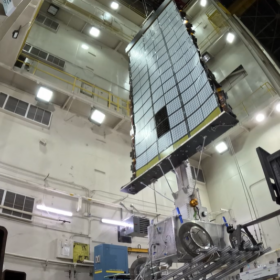
Lockheed Martin developing vertical solar arrays for the Moon
The defense and aerospace company’s vertical solar array technology (VSAT) reaches up to 19.8 m in length. Lockheed Martin says the technology is capable of providing continuous and sustainable power for a range of lunar operations.
