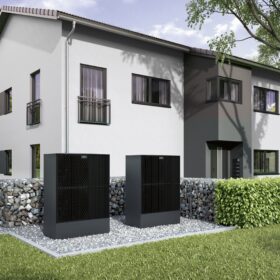
Viessmann launches new residential air-to-water heat pumps
The Germany manufacturer said its new heat pump systems use propane (R290) as the refrigerant and are able to provide a maximum flow temperature of 70 C. Their coefficient of performance ranges from 4.7 to 5.1.
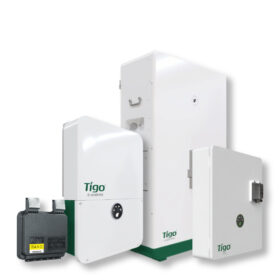
Tigo Energy releases off-grid solar package
The off-grid solution includes module optimizers, an inverter, a battery, and an automatic transfer switch.
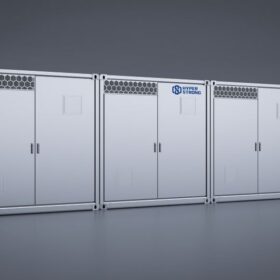
HyperStrong unveils utility-scale battery storage system housed in 10-foot container
The MagicBlock utility-scale storage platform supports two-hour to eight-hour discharge durations, targeting flexibility markets and long-duration energy storage needs. The 10-foot container supports a maximum capacity of 3.2 MWh and is available in both AC- and DC-coupled versions.
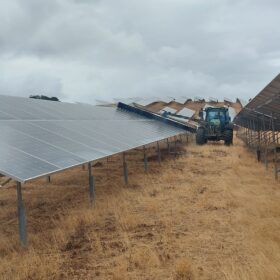
Chemitek Solar launches new antistatic soiling mitigation coating
The Portuguese company said its new anti-soiling solution lasts for at least a year. It can be applied during routine cleaning operations by mixing it directly in the cleaning water.
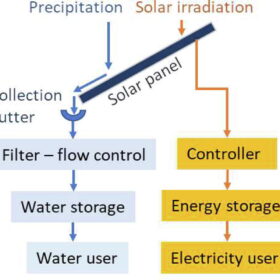
How to combine photovoltaics with rainwater harvesting
Scientists have developed a system that harvests rainwater running off PV panels for household use or hydrogen production. Their analysis showed that, in the southern Sahel, the system can meet both the energy and water requirements for electrolysis, with surplus rainwater covering up to 50% of a household’s daily water demand.

Japanese scientists build bendable perovskite-silicon tandem solar cell with 26.5% efficiency
The tandem device is based on a bottom thin-film heterojunction cell that can bend and a top perovskite cell that can be manufactured with a low-temperature process to prevent damage. It achieved the highest efficiency ever recorded to date for a flexible perovskite-silicon tandem solar cell.
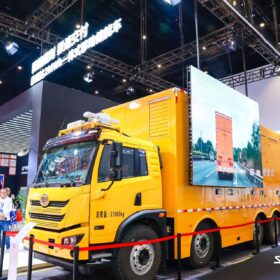
Sunwoda launches the world’s first 10-metre, 2 MWh mobile energy storage system
Sunwoda’s MESS 2000 mobile energy storage vehicle redefines the role of mobile power—evolving from a tool for emergencies to a key player in everyday energy supply.
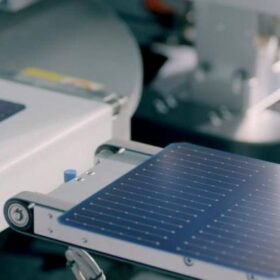
DAS Solar plans 3 GW solar module factory in France
Chinese manufacturer Das Solar says it will open its first European PV panel assembly plant in Mandeure, eastern France, by the end of 2025.

Spain’s Cegasa presents its first utility-scale battery
The Spanish manufacturer will exhibit the E/Xpand HV battery at the upcoming Smarter E show in Munich next month. It will showcase racks for commercial and industrial (C&I) and large-scale systems of up to 5 MWh.
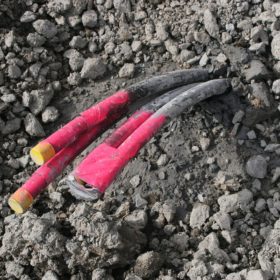
Solar-air-ground CO2 heat pump system for renewables maximization
Researchers in Italy have designed a novel carbon dioxide heat pump that can work with photovoltaic-thermal energy, a finned coil heat exchanger and a U-tube borehole heat exchanger. Their experiment has shown that the simultaneous use of at least two energy sources always results in improved system performance even with limited heat transfer areas.
