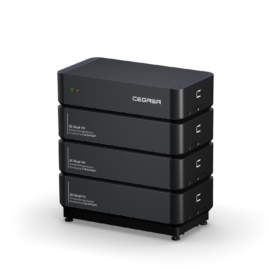
Cegasa presents new modular, scalable battery for C&I applications
The new EScal HV offers installations of between 17 kWh and 350 kWh using a stackable system that allows up to 15 modules to be placed in series, and four strings in parallel.
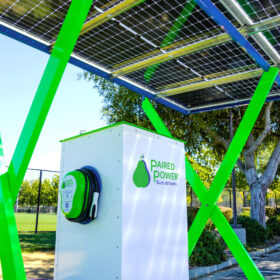
California city to install pop-up solar canopy with EV charging
The City of Campbell contracted with Paired Power to install its Pairtree solar canopy.

The Hydrogen Stream: ERM starts trials for electrolysis, desalination, transport
ERM says it has launched offshore trials to test its Dolphyn Hydrogen process, while Southern California Gas (SoCalGas) and Evoloh have completed a joint research project on electrolyzer manufacturing process and anion exchange membrane (AEM) electrolyzer tech.

VDMA expects copper metallization to take off in next 2 years
At SNEC 2024 in Shanghai, pv magazine spoke with Puzant Baliozian, lead consultant of sector group photovoltaic equipment for Germany’s Machinery and Equipment Manufacturers Association (VDMA). He says tunnel oxide passivated contact (TOPCon) technology will dominate the solar market in the next 10 years and expects module manufacturers will compete to develop more creative product designs. He also believes that copper metallization will gain market share in heterojunction (HJT) module production in the next years. “In the upcoming decade, we will have less than mg/W of silver being used for both TOPCon and HJT technologies,” he stated.

Weather standstill limits European solar production in June
In a new weekly update for pv magazine, Solcast, a DNV company, reports that, while in June Western Europe experienced below-average irradiance, Eastern Europe and the Balkans in particular saw a notable increase, resulting from persistent and static weather patterns.
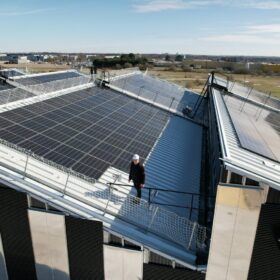
Solar on atypical, steeply sloped roofs
French company HDF Energy has equipped its new polymer electrolyte membrane (PEM) hydrogen fuel-cell production plant with a 500 kW solar project, by adjusting the PV modules and inverters to fit the sawtooth roof design.
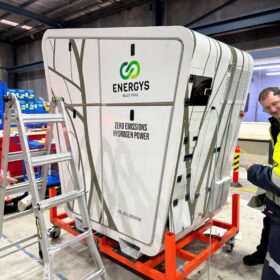
Remote telecom towers powered by 10 kW hydrogen generators
An Australian-made, 10 kW renewable hydrogen generator has been installed 120 km east of Melbourne, as part of a pilot project to provide backup to telecom towers disabled by outages.

How to make seaports into energy communities with PV, wave energy
Researchers have simulated the operation of seven renewable energy communities in the Port of Naples and found them to offer lower life cycle costs. Using varying capacities of solar and wave energy, they were able to optimize the system to a 90% self-consumption rate. They also offered a scheme for the management of a port energy community.

Solar cell based on high-entropy hybrid perovskite achieves 25.7% efficiency
Researchers in China have built for the first time an inverted perovskite solar cell relying on a high-entropy hybrid perovskite material. The result is a device with an improved open-circuit voltage and fill factor, due to reduced non-radiative recombinations and optimized interface.
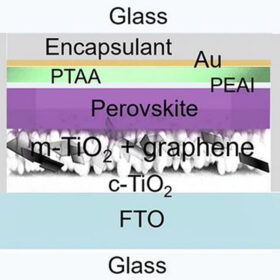
New encapsulant for perovskite solar cells, modules withstands multiple accelerated ageing tests
Researchers in Italy have developed a low temperature a blanket-cover encapsulation technique that reportedly improves the stability of perovskite PV devices. They said the new technique reduces thermomechanical stresses caused by both the encapsulation process and the temperature gradients occurring during accelerated ageing stresses.
