
EU finalizes €1 billion industrial heat decarbonization pilot auction
The IF25 Heat Auction will offer a fixed premium subsidy to projects that electrify industrial processes using technologies such as heat pumps, induction heating, solar-thermal and geothermal heat systems. The bidding window is expected to open in early December.
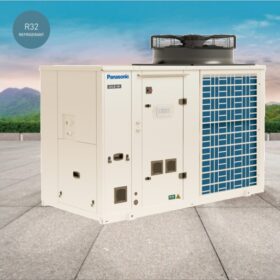
Panasonic launches new air-cooled heat pumps
The heating and cooling business of the Japanese giant has released a new range of heat pumps for commercial projects. The systems have capacities of 40 kW and 50 kW.

PV-powered transportation system for 15-minute cities
A Canadian research team has developed a framework for local urban agriculture production, with the produce harvested distributed by electric vehicles powered by sidewalk-integrated photovoltaics. The PV-powered transportation system was calculated to have a payback time of 2.8 years.
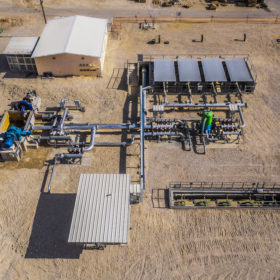
Cash flow analysis shows adiabatic compressed air storage is viable for 10–100 h applications
Scientists in the United Kingdom have compiled a new database of adiabatic compressed air energy storage projects. Using this data, they were able to determine the experience rate and identify the conditions under which the technology would be economically viable. According to their findings, costs have declined at a 15% learning rate since 2013.

Chinese scientists build 18%-efficient organic solar cells with enhanced stability
Chinese researchers have demonstrated organic solar cells with novel encapsulation and a protective interfacial layer for enhanced stability and efficiency. The best performing cell based on the new approach retained 94% of its initial power conversion efficiency after standards-based damp heat testing for 1,032 hours damp heat and across 200 thermal cycles.

Universities are turning solar furniture into campus infrastructure
As universities expand outdoor learning, off-grid solar furniture is emerging as a new class of campus infrastructure.
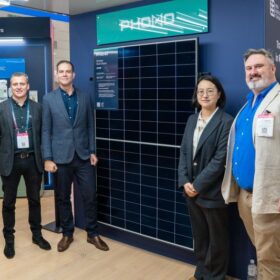
Phono launches 475 W back-contact solar panel
Chinese manufacturer Phono has launched a new bifacial solar panel in the Australian market featuring an output of 475 W and a power conversion efficiency of 23.27%.
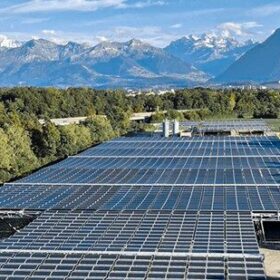
World’s largest foldable rooftop PV system comes online in Switzerland
A wastewater treatment plant in the canton of Bern has been inaugurated with what dhp Technology claims is the world’s largest foldable rooftop solar installation to date. The 3.6 MW array spans several treatment basins, allowing the existing site to serve dual purposes: wastewater treatment at ground level and solar power generation overhead.

TCL Zhonghuan unveils 25.17%-efficient TOPCon solar modules series with multi-slice design
The Chinese manufacturer said its new T5 Pro modules featues high power density and low-current, low-resistance profile. The series has a power output of 480 W to 760 W and a power conversion efficiency of up to 25.17%.
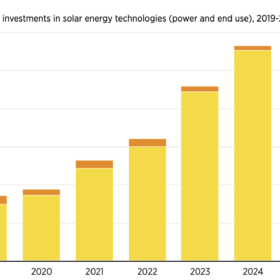
IRENA says $554 billion invested in solar technologies in 2024
The International Renewable Energy Agency (IRENA) says solar is the only renewable energy technology where current investment levels are approaching the annual average needed through to 2030 to align with its 1.5 C pathway.
