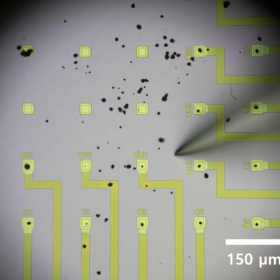
Cracked cathodes not all bad, battery scientists find
Scientists in the United States developed an innovative method to observe the inner workings of lithium-ion batteries and found that cracks which form in the electrode – something manufacturers do their best to minimize – may actually have benefits in allowing for faster charging. The work also challenges assumptions on how certain particles behave inside a battery, with potential consequences for their future design.
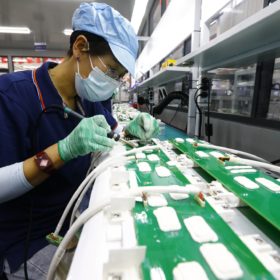
Chinese PV Industry Brief: Sineng expands inverter capacity by 25 GW
Sineng Electric says it will build a new factory in China’s Jiangsu province, while Huasun says it has commissioned 3 GW of bifacial heterojunction cell production capacity in Anhui province.
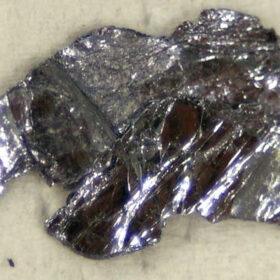
The Hydrogen Stream: Chinese scientists exploring new catalysts for hydrogen
Shanghai University scientists have started researching molybdenum-doped nickel-cobalt phosphide catalysts for hydrogen production, and Indian scientists have devised a method to produce hydrogen from methanol.
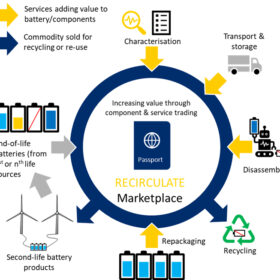
Recirculate – giving EV batteries a second-life
With the rapid growth in electric vehicle (EV) demand bringing fears of a mountain of EV battery waste piling up further down the line, the EU-Swiss government-funded Recirculate program is planning how to keep batteries in use for much longer before they head to recyclers.

Romania resumes development of 1 GW pumped hydropower project
Romania is resuming the development of the Tarniţa Lăpuşteşti pumped hydro storage project, with a planned capacity of 500 MW to 1 GW. It will be the first installation of its kind in the country.
Pexapark notes demand for renewables-plus-storage assets in Europe
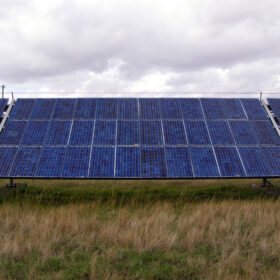
Pexapark, a Swiss consultancy, has studied energy storage drivers, value streams, contractual agreements, and regional perspectives in Europe. It says that one obstacle to deployment is the inability to properly model revenue, and notes that 15% of companies plan to use AC coupling for projects in the next three years.

New methodology to avoid mispricing the value of PV projects
A new process is described as a tool to assess the value of deferring, relocating, or abandoning PV projects under development in uncertain market conditions. It reportedly allows accommodating different sources of uncertainties with different stochastic features, as well as accounting for the various managerial flexibilities embedded in most solar projects.
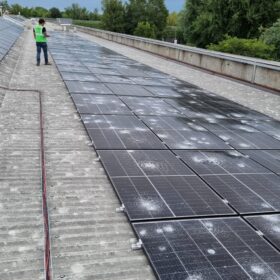
Smart O&M platform detects hail-related damages in PV systems
Massimo Albino Russo, head of business development for Enerqos Energy Solutions, recently spoke with pv magazine Italy about its smart O&M service to detect dysfunctions in solar arrays hit by hail. The Ameresco Group subsidiary uses drones and artificial intelligence to deal with PV system damage.
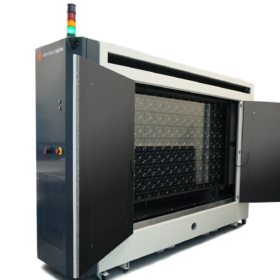
Eternalsun Spire presents LED-based solar simulator
Eternalsun Spire launched a solar simulator to test the performance, stability, and reliability of perovskite, tandem, thin film, and conventional PV technologies.
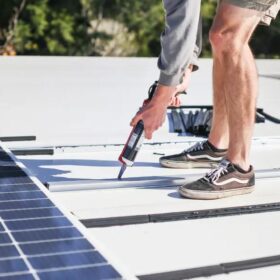
Lightweight solar panel provides solution for rooftop installations
Australian installer UV Solar has rolled out a new frameless solar panel that manufacturer GoodWe says is 60% lighter than conventional PV modules, making it ideal for rooftops that are unable to support traditional PV and racking.
