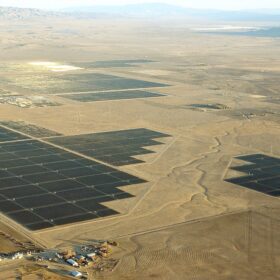
Solar becomes top source of electricity in California
Over the past 12 months, solar power has become California’s largest source of electricity, a trend likely to continue.

Cayman Islands qualifies six bidders for 22.5 MW solar-plus-storage tender
A request for proposals from six qualified bidders interested in developing a 22.5 MW solar-plus-battery project is now live in the Cayman Islands. The project will be the islands’ largest solar site to date and first to integrate battery storage.
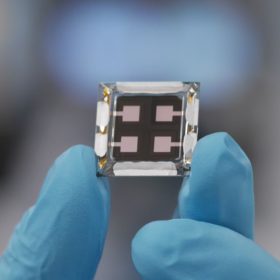
Four-year outdoor testing shows perovskite solar cells suffer from high seasonality
Testing conducted by the Helmholtz-Zentrum Berlin (HZB) in Germany has shown that perovskite solar cells operating at high latitudes in Europe may suffer from higher performance losses in winter compared to conventional PV devices. The scientists warned, however, that at lower latitudes this seasonality may be less pronounced.

Pakistan’s largest battery storage project nears operation for cement firm
Lucky Cement’s 22.7 MWh battery is the largest in Pakistan, and the project is now just months away, according to a company executive.

Record solar output in Europe drives rise in negative price hours
Record solar generation across Europe and limited storage capacity are driving a surge in negative electricity price hours, with below-zero pricing expected to hit new highs in the third quarter, according to Montel Analytics.

China on track to deploy 380 GW of PV in 2025
China is set to break new ground in its energy transition, with 2025 renewable capacity additions projected to exceed 500 GW, driven by surging solar and wind deployment, according to a new report from the State Grid Energy Research Institute.

NREL, CubicPV achieves 24% efficiency for perovskite mini solar module
A U.S.-based collaboration between the National Renewable Energy Laboratory (NREL) and CubicPV has yielded a perovskite minimodule with certified efficiency of 24.0%. The two noted that it is the first time a U.S. effort has set a record in the perovskite mini module category.

Superdielectrics unveils Faraday 2 battery as a polymer-based alternative to Li-ion
Superdielectrics launches the Faraday 2 battery, advancing a water-based, metal-free approach to home storage, from a UK-based facility.

Massive solar project progresses ahead of schedule in Philippines
More than half of the first phase of the 3.5 GW solar and 4.5 GWh battery storage MTerra Solar project in the Philippines is now complete, eight months after its groundbreaking. The 778 MW of solar installed so far makes it the largest solar installation in the country.
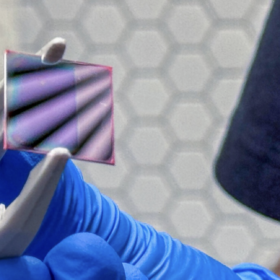
Researchers discover method to significantly extend quantum battery lifespan
Researchers at the Royal Melbourne Institute of Technology (RMIT University) and Australia’s Commonwealth Scientific and Industrial Research Organisation (CSIRO) have developed a way to extend the lifetime of Dicke quantum batteries by up to 1,000 times, while maintaining their fast-charging properties enabled by superradiance.
