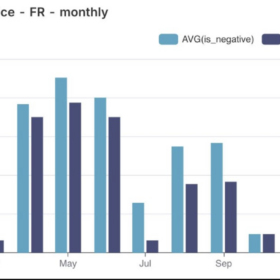
French electricity posts first negative prices of 2026, battery storage gains
February marked an early 2026 turning point in France’s electricity market, with negative prices emerging for the first time, intraday volatility spiking, and battery energy storage systems (BESS) capturing growing revenue opportunities.

ACME Solar signs 450 MW PPA in India, commissions new 38 MW/82 MWh BESS
ACME Solar has signed two power purchase agreements (PPAs) totaling 450 MW under a firm, dispatchable renewable energy (FDRE) project with SJVN Ltd. It also commissioned an additional 38 MW/82 MWh at its Jaisalmer battery energy storage system (BESS) facility in Rajasthan.

Freight costs increase following military strikes in the Middle East
Freight costs from the Far East to the U.S. and Europe have increased week-on-week, while almost 150 container ships currently unable to leave the Arabian Gulf due to the risk of sailing through an active conflict zone, according to analysis from ocean and freight rate benchmarking platform Xeneta.
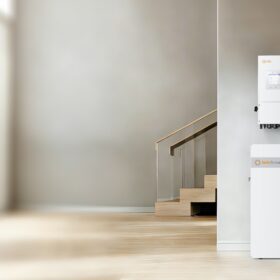
Solis launches new residential storage system portfolio
The Chinese manufacturer said its new three residential battery lines support a depth of discharge of 90% and deliver over 6,000 cycles.
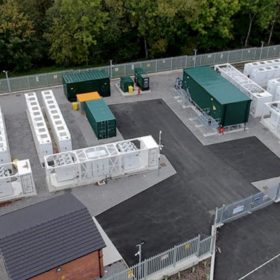
Battery storage awarded 576 MW in UK top-up capacity market auction
Battery energy storage system (BESS) and demand-side response assets both secure roughly 8% of capacity agreements, according to provisional results, but nuclear leads the pack in first UK capacity market auction of 2026. Results from larger T-4 auction expected later in the month, with generators and energy storage assets vying for multi-year contracts.
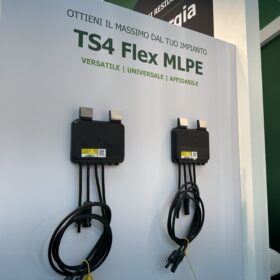
Tigo debuts 725 W optimizer for high-power solar modules
The new product has a maximum wattage of 725 W, a maximum current of 22 A, and a maximum efficiency of 99.6%.

BYD unveils EV batteries that can recharge in 10 minutes
The Chinese electric vehicle maker said the new batteries can charge from 10% to 70% in 5 minutes and from 10% to 97% in 9 minutes. The company also announced a new generation of its Flash Charging Technology.
US solar’s push for domestic bliss
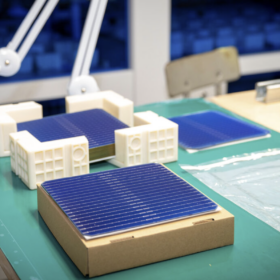
Incentives in the US Inflation Reduction Act (IRA) of 2022 drove a wave of new solar manufacturing announcements, and the country now has more than enough module capacity to meet domestic demand for several years. Policy shifts have created uncertainty, but continued tax credits and a focus on domestic industry have US manufacturers planning to expand cell and component production.
China TOPCon module prices edge higher as March cargoes clear
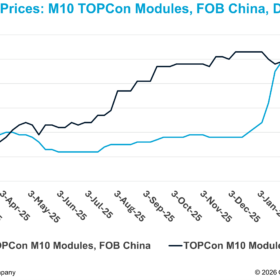
In a new weekly update for pv magazine, OPIS, a Dow Jones company, provides a quick look at the main price trends in the global PV industry.

China’s polysilicon prices fall again amid 480,000 MT inventory buildup
Global solar supply chains face renewed price pressure as weak post-holiday demand in China collides with high polysilicon stockpiles, pushing wafer costs lower and weighing on exporters ahead of policy changes.
