
Aiko Solar wins second patent dispute against Maxeon in Netherlands
A Dutch court has rejected Maxeon Solar’s request for a preliminary injunction against China’s Aiko Solar in a dispute over EP2297788B1, a back-contact (BC) solar cell patent.
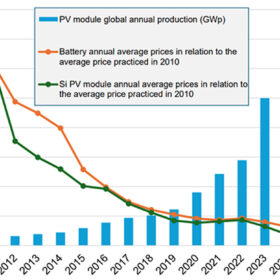
Falling Li-ion battery prices mirror solar photovoltaics trends: Is there a role for second-life batteries before recycling?
Lithium-ion batteries are everywhere, powering everything from consumer electronics to electric vehicles, residential PV storage systems, and, more recently, mitigating curtailment in large-scale wind and solar power plants. EVs are driving large-scale demand for Li-ion batteries which will result in substantial volumes of spent batteries in the near future. This scenario highlights the potential for repurposing EV batteries for second-life stationary applications, which could maximise their value before recycling. However, to fully realise this opportunity, several economic, technical, and regulatory challenges must be addressed and resolved.

Argentina publishes details of 500 MW battery tender
Argentina’s AlmaGBA tender for the Buenos Aires metro area will pay a fixed $10/MW of electricity supplied, with storage capacity bids capped at $15,000/MW per month.
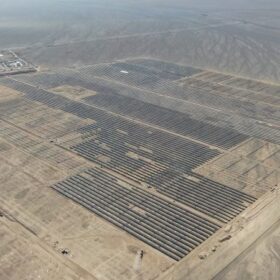
Engie breaks ground on 199 MW/995 MWh solar-plus-storage Chilean project
The site, now in its initial construction phase, will be the company’s first energy project in the Santiago Metropolitan Region.

Improving perovskite solar cell durability via formamidinium cations
A team of São Paulo-based researchers have found incorporating formamidinium cations into methylammonium-based lead iodide perovskite films increases the durability of perovskite solar cells when fabricated and measured under ambient conditions.

Eskom tenders green hydrogen pilot in South Africa
South African utility Eskom is searching for a developer to engineer, procure and construct a renewable green hydrogen facility at its research unit in Johannesburg. The deadline for applications is June 27.
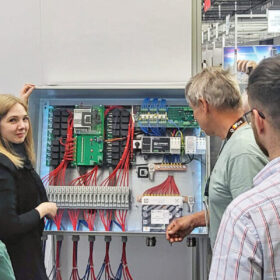
Q3 Energy presents string combiner box with fault detection
Q3 Energie showcased a new string combiner box at Intersolar Europe 2025. The generator junction box can detect and isolate faults in photovoltaic systems.
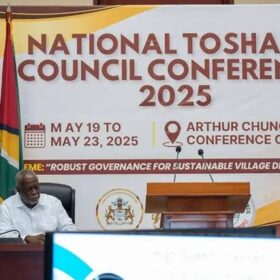
Guyana purchases solar systems for 21 villages
Guyana has approved a GYD 885 million ($4.2 million) investment to retrofit solar systems across 21 Amerindian villages, expanding the country’s off-grid solar rollout in four administrative regions.
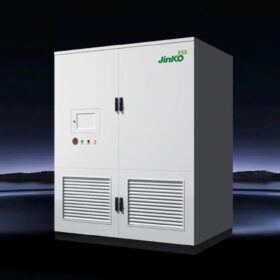
Jinko unveils 520 kWh C&I battery storage system
Jinko ESS has launched a new modular 520 kWh battery energy storage system for commercial and industrial users. The product will be available for global shipment in Q3 2025.
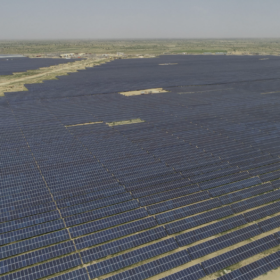
Adani Green, Acme Solar add 300 MW to India PV project pipeline
Adani Green and Acme Solar have ramped up their utility-scale solar footprints in India with new project activations in Gujarat and Rajasthan, respectively.
