
Tata Power begins solar cell production at 4.3 GW plant in India
Tata Power’s TP Solar subsidiary has started commercial production of solar cells with an initial capacity of 2 GW at its 4.3 GW integrated PV cell and module plant in the Indian state of Tamil Nadu.

Japanese scientists build heterojunction solar cell based on titanium dioxide, selenium
Scientists in Japan developed a 4.49%-efficient solar cell based on titanium dioxide and selenium. The devices is based on a new approach aimed at reducing interfacial recombination and increasing open-circuit voltage and efficiency.

Midea presents 4.5 kW residential heat pump
The Chinese manufacturer said its new propane heat pump doesn’t need an outdoor unit and is able to operate with temperatures down to -20 C.

Actis invests in 3.5 GW/4.5 GWh of solar-plus-storage in Philippines
Private equity investor Actis has become a strategic partner in a 3.5 GW/4.5 GWh solar-plus-storage project in the Philippines. The project is poised to become the world’s largest integrated renewables and energy storage installation upon completion. Actis is investing $600 million for a 40% equity stake.

Clime Capital invests $10 million in PV developer in Philippines
Singapore-based fund manager Clime Capital is investing up to $10 million in Upgrade Energy Philippines (UGEP). The money will go toward supporting commercial and industrial (C&I) and utility-scale solar deployment.

India proposes ALMM mandate for solar cells from April
India’s Ministry of New and Renewable Energy (MNRE) has started accepting feedback on draft guidelines for the Approved List of Models and Manufacturers (ALMM) for solar cells. The MNRE plans to implement the guidelines from April 2026.

Lightweight ventilated BIPV system for low-load rooftop applications
Scientists in China have designed a ventilated building-integrated photovoltaic system that relies on flexible solar modules with a weight of 6 kg/m2. The system also uses an airflow channel under the PV panels to reduce their operating temperature and increase their power yield.

Terpyridine-passivated perovskite solar cells achieve 25.24% efficiency
An international team of researchers demonstrated perovskite solar cells treated with a molecular passivator based on π-conjugated terpyridine Lewis-base molecules that achieved 25.24% power conversion efficiency, with 90% retained after 2,664 hours of light exposure. The treatment reportedly works at high concentrations without damaging the perovskite film or diminishing cell performance. A protocol was published to reproduce the results, opening the door to testing it on a range of perovskite absorbers.
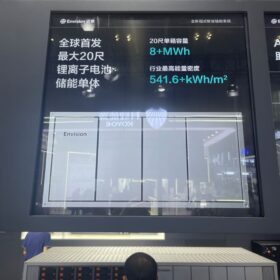
Envision pushes energy storage density to new highs with 8 MWh, 20-foot container
Chinese multinational Envision Energy has unveiled the world’s most energy dense, grid-scale battery energy storage system packed in a standard 20-foot container.
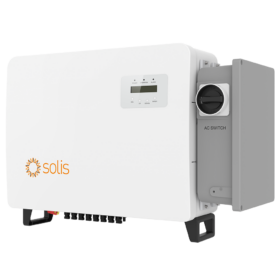
Solis launches 60 kW and 125 kW string inverters for US, Canadian markets
Solis has developed new 125 kW and 60 kW string inverters for the US and Canadian markets, both with a maximum efficiency of at least 98.5%
