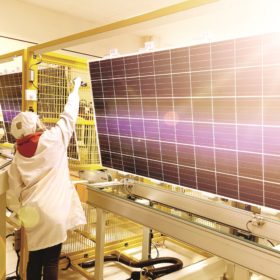
Chinese PV Industry Brief: Canadian Solar, Aiko Solar to build new factories
Canadian Solar says its new 14 GW vertically integrated cell and module factory will require an investment of CNY 9.63 billion ($1.33 billion), while Aiko Solar says it will invest CNY 9.97 billion in a 10 GW facility.

CleanMax to develop 45.9 MW of solar, wind under PPA in India
Clean Max Enviro Energy Solutions (CleanMax) says it will build a 45.9 MW solar-wind project under a power purchase agreement (PPA) in Karnataka, India. It will consist of 36 MW of solar and 9.9 MW of wind capacity.

Indonesian government abolishes net metering
The Indonesian government has ended net metering for rooftop solar installations. The Jakarta-based Institute for Essential Services Reform says this could make it harder for the country to meet its solar deployment targets, as PV installations will become more expensive for households and small businesses.
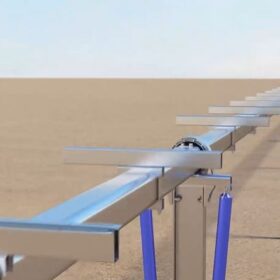
Trina Solar unit releases new version of Vanguard 1P solar tracker
TrinaTracker, a division of China’s Trina Solar, says its new Vanguard 1P tracker system has a maximum length of 140 meters and can be equipped with N-type modules.
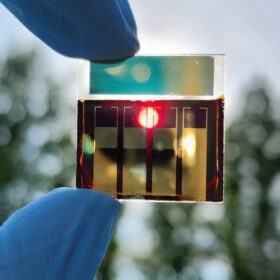
Korean scientists build semi-transparent perovskite solar cell with record-breaking efficiency of 22.02%
Developed by researchers at the Korea Institute of Energy Research (KIER), the novel cell was conceived for applications in bifacial perovskite-silicon tandem PV devices. The academics claim they were able to overcome an intrinsic dopant-induced internal degradation mechanism which leads to undesired lithium-ion diffusion that would have been detrimental to the cell efficiency.
EDP Renewables wins Singapore’s largest public solar tender
EDP Renewables has won Phase 8 of Singapore’s SolarNova program, the country’s largest public solar tender to date. The developer will install up to 200 MWp of rooftop PV capacity.
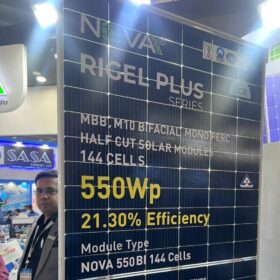
India’s Nova Solar expanding PV module capacity to 1.2 GW
Nova Solar (Novasys Greenergy) says it will reach a PV module production capacity of 1.2 GW per year with the commissioning of new stringer machines in the middle of April.
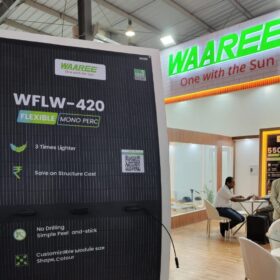
Waaree showcases 420 W mono PERC flexible solar modules
Waaree says its FLW series of flexible, lightweight solar panels can be seamlessly integrated into a diverse range of environments. It claims that they are ideal for applications in which traditional, rigid panels could pose challenges.
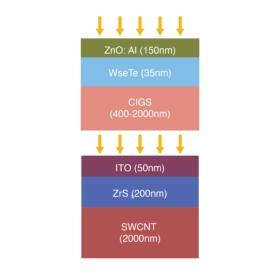
First attempt to design CIGS/SWCNT tandem solar cells promises 38.91% efficiency
Indian researchers have proposed to build tandem solar cells based on a CIGS top cell and a bottom cell relying on a single-walled carbon nanotube (SWCNT) absorber. SWCNTs were previously used in solar research as an alternative to conventional metal grid contacts or hole transport layers (HTLs), as they combine optoelectronic properties, flexibility, chemical stability, and simple transfer protocols.
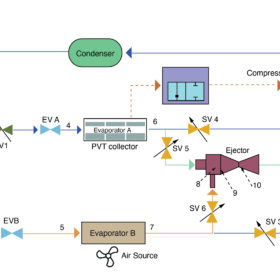
PVT-assisted heat pump for residential water heating
A group of scientists in China has designed a residential heat pump system with a potential cofficient of performance of 4.271 at -5 C. The system is reportedly able to adjust the required pressures based on solar irradiance intensity and ambient temperature
