
Spain’s Acciona advances 2.4 GW of energy storage, 1.8 GW solar-wind hybridization
Acciona Energía has just launched its second hybrid wind-solar project in Spain, at Villalba del Rey and Tinajas. A new, 19.7 MWp solar field has been added to a 26 MW wind complex.
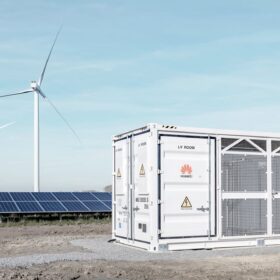
Vattenfall enters large-scale battery storage business
The energy company announced plans to invest extensively in large-scale battery business in response to the growing demand for flexibility, adding 500 MW of battery storage annually.

Italy’s regional governments approve 5.1 GW of utility-scale PV projects in January-September period
Italy’s regional governments approved 5.1 GW of solar in the first nine months of this year, with Sicily leading by approving around one-third of the total new capacity.

Panasonic, Innova developing PV-compatible multi-source heat pump combined with PCM
The novel heat pump concept should enable ready-to-use energy storage even in already existing installations. It features capabilities that easily detect self-consumption of PV energy, maximizing the amount of energy that can be produced and consumed on-site
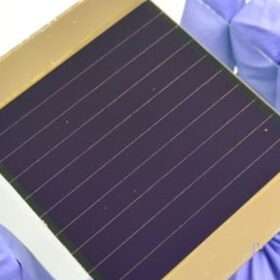
Perovskite solar module achieves 21.44% efficiency via new passivation tech
Researchers have developed a novel passivation process for formamidinium lead iodide perovskite films, which reportedly resulted in solar cells with 23.69% power conversion efficiency, and modules with 21.44% certified efficiency. After 1000 hours, the hetero-polytypic passivated devices maintained 92% of their initial efficiency, outperforming untreated devices.
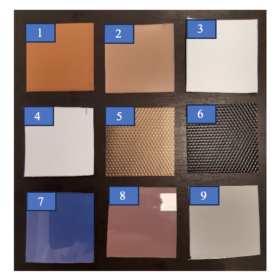
French startup develops colored flexible CIGS solar modules
France-based Solarcloth tested and compared three colored solutions: MorphoColor interference sheets from the German Fraunhofer Institute; ColorQuant interference encapsulants from the German company Lenzing Plastics; and diffuser films from Switzerland-based Solaxess.
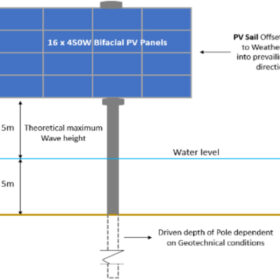
Rotating, vertical floating PV system for offshore applications
An international group of scientists has designed a patented mooring tech and a vertical PV system that reportedly allows the bifacial solar panels to align with the prevailing wind direction to shed wind loads. Depending on a project’s latitude, the system can deliver different power yield.
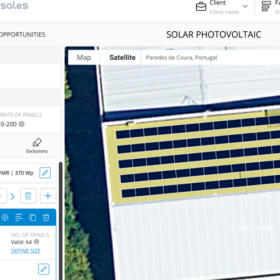
Effizency launches web-based simulator providing PV system, heat pump prices, savings
Portugal-based Effizency, a developer of sales software for solar PV and heat pump solution providers, has launched a new web-based simulator module that its customers can use to deliver initial price quotes and savings estimates to potential buyers.
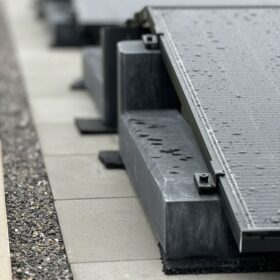
Wattstone launches new concrete bases for rooftop PV
The German company said its new products are suitable for PV systems with tilt angles ranging from 0 to 15.6 degrees.

Quantifiying benefits of vehicle-integrated photovoltaics
Austrian researchers developed a model to quantify the benefits of vehicle integrated photovoltaic (VIPV) on the energy needs of three different sizes of electric vehicle in the city of Graz, Austria, particularly the effect on battery energy and vehicle mileage.
