
GCL, Cornex, TBEA to build solar manufacturing complex in Egypt
Egypt’s Kemet has signed three agreements with Chinese companies over the last week, covering plans for a 5 GW solar cell complex, a 5 GWh battery energy storage factory and Egypt’s first solar inverter factory.

The Hydrogen Stream: Scatec-led 100-MW green project in Egypt to step operations in the coming months
The consortium expects to reach Final Investment Decision (FID) on the full-scale project in the Ain Sokhna Industrial Zone in the coming months, while Brazil’s Federal Court provisionally ordered the suspension of construction activities of Solatio’s project in the State of Piauí.
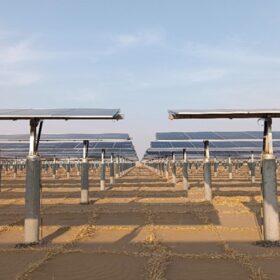
MENA region installs 12.2 GW of solar in 2025
Latest report from energy think tank Dii Desert Energy says that with the Middle East and North Africa’s project pipeline of renewables now standing at 202 GW, solar is likely to drive the region past its aggregated national ambitions for renewables of 235 GW by 2030.
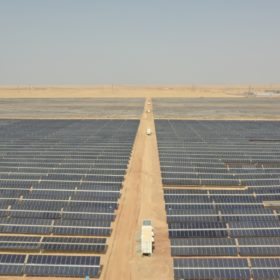
Scatec secures PPA for Africa’s largest solar-plus-storage project
Scatec has inked a 25-year power purchase agreement in Egypt for a 1.95 GW solar, 3.9 GWh battery energy storage project, representing the developer’s largest investment to date.
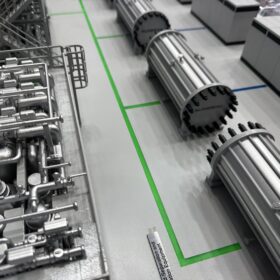
The Hydrogen Stream: RWE commissions 100 MW hydrogen electrolyzer
RWE has started commissioning a 100 MW electrolyzer in Germany to supply renewable hydrogen under long-term contracts, while Hydrogen Utopia International and Hydrogen Systems are advancing plans to build waste-to-hydrogen plants in Saudi Arabia.
Amea Power begins construction on 1 GW/600 MWh solar-plus-storage plant in Egypt
According to the developers, the $700 million giant project will be Africa’s largest single-site hybrid renewable facility. Amea Power began construction before financing was completed.
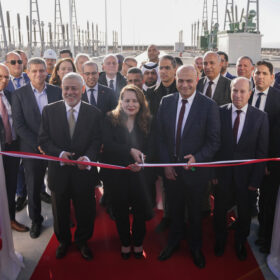
Tunisia switches on largest solar project to date
UAE-based Amea Power has completed a 120 MW solar project in Tunisia, the country’s first above 100 MW.
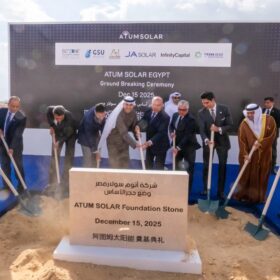
JA Solar joins consortium building $210 million PV module factory in Egypt
The 200 square meter facility is targeting an annual manufacturing capacity of 2 GW of solar cells and 2 GW of solar modules. The solar cell production will be 100% for export.
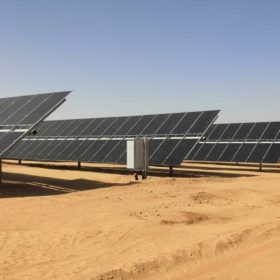
EDF Power Solutions to take 20% stake in Scatec solar-storage project in Egypt
Oslo-based Scatec ASA says it will retain majority ownership in Egypt’s 1.1 GW solar and 100 MW/200 MWh Obelisk project, with EDF Power Solutions taking 20% and Norfund 25%.
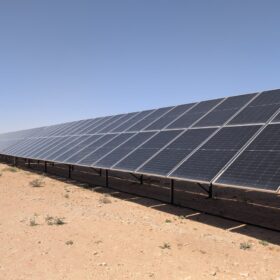
Tunisia accelerates large-scale solar as new players enter market
The Tunisian government says concession and authorization frameworks are advancing multiple PV projects, while new entrants including SoleCrypt plan additional plants, boosting capacity, self-generation, and panel imports.
