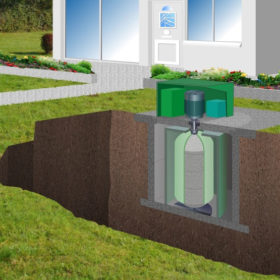
Concrete flywheel storage system for residential PV
A French start-up has developed a concrete flywheel to store solar energy in an innovative way. Currently being tested in France, the storage solution will be initially offered in France’s overseas territories and Africa.
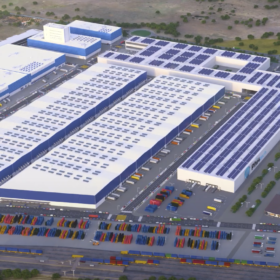
Construction begins on Spain’s first gigafactory
The factory is located in Noblejas, in the province of Toledo, Castilla–La Mancha, and is planned to reach a capacity of 10 GWh by 2025.
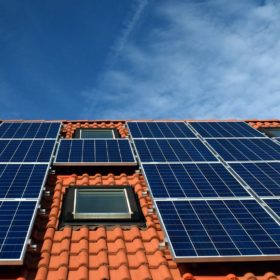
Italy has 189 MW/295 MWh of distributed storage capacity
The country added around 73.5 MW/109.2 MWh of new, small-sized storage capacity in 2020. Most of the batteries are in Lombardy and Veneto, where rebates are being offered.
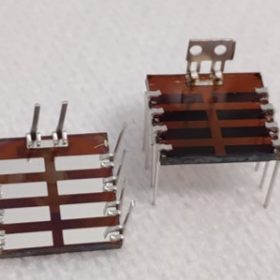
Black perovskite solar cell with 15% efficiency via thermal evaporation
The cell exhibited an open-circuit voltage of 1.1 V and was able to retain around 90% of its initial performance after 215 days of exposure to dim light at room temperature. According to its creators, this performance and the notable stability were ensured by the thermal evaporation technique used for depositing the perovskite layers onto the cell.
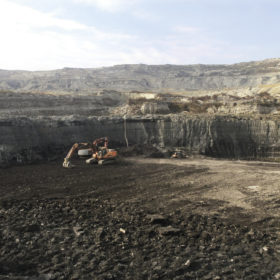
The weekend read: Greek solar investment soars
An array of new investment plans were announced in Greece in May, ranging from mega PV projects to battery and electric vehicle production, as well as a move to smart green islands. pv magazine explores the state of these investments and links them to the country’s general policy frameworks – most notably, Greece’s master plan to boost green investments in former lignite regions and establish a new type of economy.

Lightsource BP buys 703 MW of PV projects in Spain, seeks off-takers through tender
The U.K.-based solar developer wants to identify potential buyers for the electricity generated by the facilities through competitive bidding.

Solar mandatory on new buildings in Berlin from 2023
Under the new provisions, which will come into force in 2023, a photovoltaic system will have to cover at least 30% of the roof area of a new building.

Flexible perovskite solar module with 10.5% efficiency
The methylammonium-free inverted solar module was built on a flexible substrate made of polyethylene terephthalate (PET). A hole transporting material made of poly(triarylamine) (PTAA) and a double-cation cesium formamidinium (CsFA) perovskite layer were deposited through blade-coating and nitrogen-assisted blade-coating.

Austria deployed 341 of new PV in 2020
The country’s cumulative PV capacity exceeded 2 GW at the end of 2020.

Greece’s 680 MW pumped storage project seeks investors
Developer Terna Energy claims the Amphilochia pumped hydroelectric energy storage project has entered the final stretch. If built, the large scale facility can boost Greece’s independence from fossil fuels and the government’s strategy for a coal-free electricity system by 2025.
