
100 MW Hertz 1 battery enters operation after Estonia–Finland grid incident
The 100 MW/200 MWh battery energy storage project in Kiisa began operation on Feb. 3 as scheduled – just two weeks after a testing fault at the facility caused the most significant disturbance to the regional power grid since Estonia’s desynchronization from the Russian electricity system.
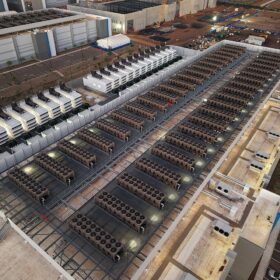
Battery management systems key to deploying batteries in data centers
A new study highlights the critical role of advanced AI-integrated battery management system technologies in monitoring, optimizing, and predicting battery performance for reliable and sustainable data center operations.

New surface texturing boosts TOPCon solar cell efficiency by 1%
Chinese researchers have demonstrated a single-step submicron structured surface texturing process that improved the absolute efficiency of a TOPCon solar cell by 1% through broadband anti-reflection and lower electrical resistance. The cell-level performance was validated in laboratory and outdoor tests.
Germany, France, Netherlands curtail 3.9 TWh of renewables in 2025
Analysis by energy advisory service Montel finds Germany, France and the Netherlands all saw record levels of renewables curtailment last year, with the build out of solar in each market contributing to midday generation peaks and consequential price cannibalization.

Finland adds 227 MW of utility-scale solar in 2025
Finland’s large-scale solar capacity more than doubled in 2025, buoyed by the commissioning of the country’s first solar projects larger than 50 MW. Another record year for ground-mounted solar is expected this year but a forthcoming Land Use Act risks threatening future projects.

Spain deploys 1.13 GW of solar for self-consumption in 2025
Spain installed 1.14 GW of solar capacity for self-consumption in 2025, lifting cumulative capacity to 9.3 GW, as residential and commercial installations declined while industrial and off-grid segments showed greater resilience, according to data from the Spanish Photovoltaic Union.

The impact of microclimate effects on floating PV plants
French researchers have developed a high-resolution computational framework to model microclimate effects of large floating solar PV systems, enabling accurate predictions of heat transfer, ambient temperatures, and water evaporation based on panel configuration and wind conditions. The model can inform thermal performance, environmental impacts, and optimize designs for utility-scale floating PV, as well as ground-mounted and agrivoltaic installations.

Reducing PV module temperature with leaf vein–inspired fins
Researchers in Iraq have developed biomimetic leaf vein–inspired fins for photovoltaic panels, with reticulate (RET) venation reducing panel temperature by 33.6 C and boosting efficiency by 18% using passive cooling. Their study combines 3D CFD simulations and electrical evaluations to optimize fin geometry, offering a sustainable alternative to conventional cooling methods.
The Hydrogen Stream: Repsol, Sunfire advance 200 MW of green H2 in Spain
Repsol and Sunfire are advancing 200 MW of renewable hydrogen projects in Spain, while new collaborations and funding across Europe and India aim to accelerate electrolyzer development and hydrogen infrastructure.

TheStorage launches its first industrial-scale sand-based heat storage system
The Finnish start-up says its sand battery technology is scalable from 20 to 500 MWh with charging power from 1 to 20 MW, depending on industrial needs.
