
Enhancing PV glazing prospects in solar architecture
To make it easier to adopt building integrated PV (BIPV) as a glazing material, a group within the IEA Photovoltaic Power Systems Programme (IEA-PVPS) has tackled the solar heat gain coefficient (SHGC) calculation for BIPV. It is part of IEA PVPS Task 15 international standardization efforts.

Colored modules for building-integrated photovoltaics
Taking inspiration from the 3D photonic structures on a Morpho butterfly’s shimmering blue wings, scientists at Germany’s Fraunhofer Institute for Solar Energy Systems ISE have developed colored solar panels that can be incorporated into a building’s exterior practically invisibly while maintaining high efficiency.

Polyshine Solar unveils ultralight, flexible rooftop solar panels
The Chinese manufacturer said its new flexible modules have an efficiency of up to 20.1% and a weight of only 7.5 kg, or 2.92 kg/m2. The new products have purportedly a light transmittance of over 91% and “ultra-high” UV blocking ability.
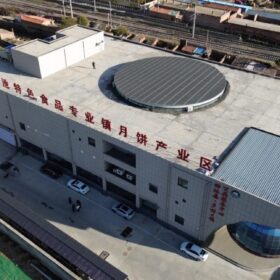
Microquanta developing perovskite solar modules for BIPV applications
The Chinese perovskite solar cell and module maker said its custom-designed double-glass perovskite modules measure 1,200 mm x 1,000 mm and achieve a light transmittance of around 40%.

U.S. startup unveils ‘world’s largest’ transparent organic PV window
Next Energy said its 101.6 cm x 152.4 cm laminated transparent power-generating windows were produced with its pilot production line.
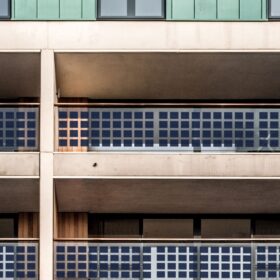
Mitrex launches solar PV railing systems
The Canadian building-integrated PV manufacturer has launched semi-transparent and opaque solar PV railing systems for balconies or walkways, for retrofit or new buildings. The products are delivered with support bars, concealed cabling and a choice of mounting systems.

Testing shows BIPV using patterned glass performs better than expected
Scientists have compared conventional PV modules to self-made BIPV panels with thicker, patterned glass. They tested them both under standard conditions and outdoors under Korean summer conditions. Yield was found to be only 0.5% lower in the textured BIPV module.
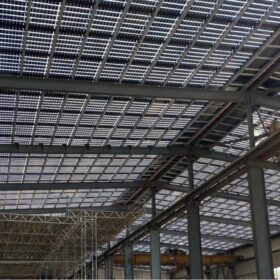
Swiss startup launches 400 W transparent BIPV panels
Climacy, a building integrated PV manufacturer, has launched a new semi-transparent 400 W glass-glass panel that is suitable for use in roofs or facades in residential, industrial and commercial buildings. When used as a roof or wall componentt, the 20% transparent panels reportedly allow more natural light into interior spaces than conventional PV designs.

Roofit.Solar releases new BIPV panels with narrow roof coverage
Estonia’s Roofit.Solar has developed new building-integrated photovoltaic (BIPV) panels with an effective width of 470 mm, offering power outputs of 120 W or 180 W.
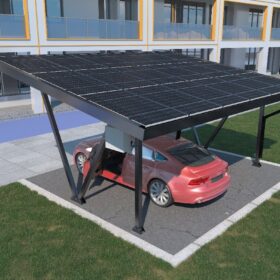
Mibet launches waterproof solar carport
The Chinese company said that its new product has a drainage edge that ensures complete waterproofing. It can purportedly withstand wind speeds of 45 m/s and a snow load of 1 KN/m².
