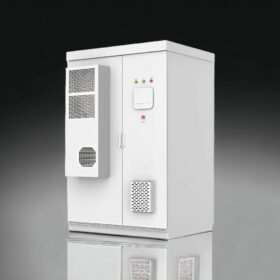
Chelion unveils scalable battery storage solution
Chelion Australia, an energy storage solutions specialist, has developed a new all-in-one lithium iron phosphate battery cabinet for commercial applications.
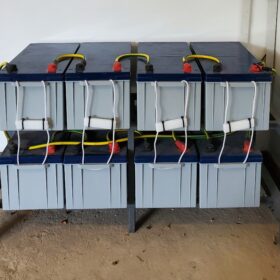
German consumer group debunks residential battery misconceptions
Verbraucherzentrale NRW, a German consumer protection association, has issued a warning about five misleading assumptions about PV-linked residential battery systems.
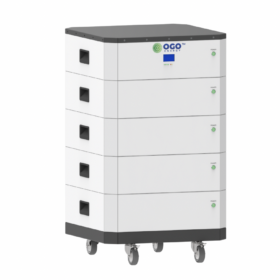
OGO Energy introduces residential battery storage solutions
India’s OGO Energy has developed modular battery energy storage systems with smart management capabilities. Up to five battery modules of 5.12 kWh each can be combined for a total storage capacity of 25.6 kWh.
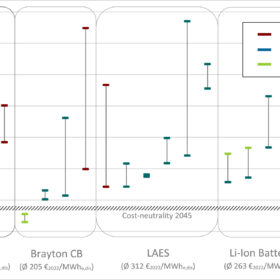
The economics of storing renewables with Carnot batteries
A group of researchers in Denmark has investigated how Carnot batteries may be used to store renewable energy in their home country and have found that these devices may provide a significant contribution only under a certain cost threshold.
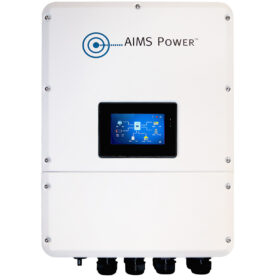
Aims Power introduces hybrid inverter for solar-battery systems
Aims Power has developed a hybrid inverter for solar-battery systems, with power outputs of 4.6 kW and 9.6 kW and solar input capacities of 6.9 kW and 15 kW.
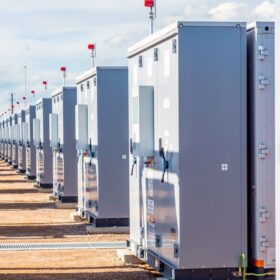
AGL goes live with second biggest battery in Australia
Australian energy giant AGL has officially opened its first operational grid-scale battery – the 250 MW/250 MWh facility at its Torrens Island power station site in South Australia.
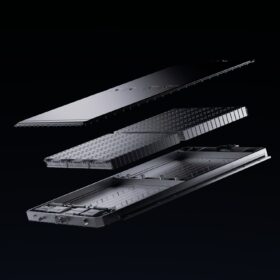
CATL unveils EV battery enabling a 400 km driving range on a 10 minute charge
Chinese battery industry heavyweight Contemporary Amperex Technology (CATL) announced a new electric vehicle battery that reportedly enables long-range driving on a fast, ten-minute charge. It expects mass production to begin by the end of this year, and vehicles equipped with the battery to be available in the first quarter of 2024.

South Korea opens tender for 65 MW/260 MWh of battery storage
The South Korean authorities have kicked off a tender for 65 MW/260 MWh of storage capacity, in support of extensive battery systems on Jeju Island.
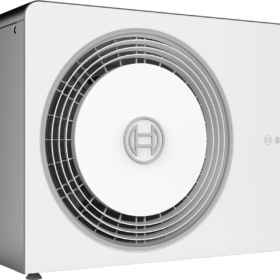
Bosch sells new propane heat pumps with PV packages
Bosch is currently selling the new heat pumps in the DACH markets and is planning to expand sales in other European markets in September. The new products use propane as the refrigerant and integrated sound diffusers. The manufacturer is also offering a power meter/sensor enabling the heat pumps to work with any existing PV system and battery storage solution at home.
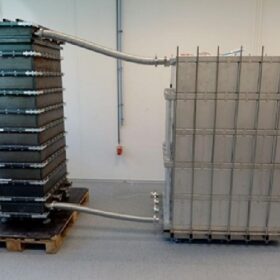
Solar-driven heat battery for residential applications
Developed by scientists in the Netherlands, the heat battery prototype consists of a storage module based on potassium carbonate and an electricity-driven mechanical system that maintains continuous charging or discharging powers. Through a series of simulations, the research group found that the device can significantly reduce a dwelling’s electricity consumption for heating.
