
Enervis launches 24/7 PPA Platform
Enervis has launched its 24/7 PPA Platform to accelerate the adoption of 24-7 power purchase agreements (PPA), which match every hour of electricity consumption with carbon-free generation. The initiative models five PPA alternatives against a baseload benchmark.
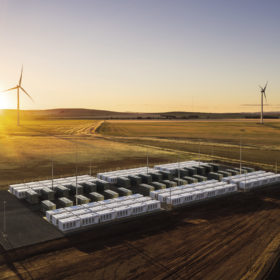
Volta’s 2024 Battery Report: Falling costs drive battery storage gains
The 500 page report offers a full picture of the battery industry, including a deep focus on battery energy storage systems (BESS).

Octopus Energy CEO: Powering bargains with renewables
At the recent World Future Energy Summit in Abu Dhabi, Octopus Energy’s founder and CEO Greg Jackson urged market participants in the renewable energy sector to tap low-cost renewables to drive both clean energy adoption and acceptance. His speech was part of IRENA’s Innovation Day at WFES on January 14, 2025 and set the scene for a subsequent panel discussion on the topic “Digitalization to support the 3x Renewables Goal.”
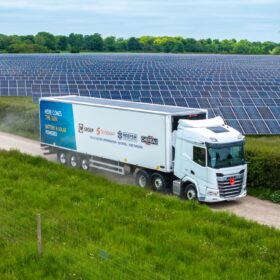
Sunswap expands production of PV-driven transport refrigeration units
Sunswap brings manufacturing in-house at headquarters in Leatherhead, near London, following a successful fundraising round. Offering solar and battery-powered refrigeration for transport, the UK business has international ambitions.

HyperStrong lists on Shanghai stock exchange, surges 230% on its first day
The Chinese battery energy storage system (BESS) integrator debuted on the stock exchange with a market capitalization of RMB 11.339 billion ($1.56 billion).
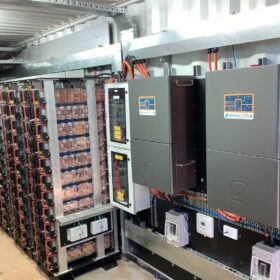
Australian manufacturer bets on lithium-titanium-oxide batteries
Zenaji, an Australian manufacturer of lithium-titanium-oxide (LTO) batteries, says the LTO market will hit $5.8 billion by 2032, growing at a 12.6% annual rate. It claims that its Eternity battery system is poised to capitalize on the trend.
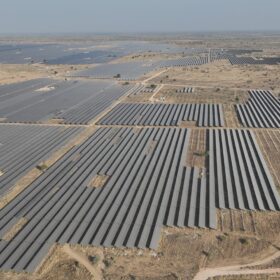
Acme Solar secures PPA with NHPC for 680 MW renewables storage project
India’s Acme Solar has signed a power purchase agreement (PPA) with state-owned NHPC Ltd. for a 680 MW renewables storage project.
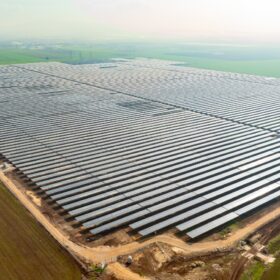
Teralight switches on Israel’s largest solar plant
Teralight has activated Israel’s biggest PV project, the 150 MW Ta’anach 1 array, which will produce 310 GWh of energy per year. The facility will be expanded next year with the 104 MW Ta’anach 2 installation, featuring 440 MWh of energy storage.

EMPA develops biodegradable fungi battery
A team from the Swiss Federal Laboratories for Materials Science and Technology (Empa) has developed a 3D-printed battery. Fungi are used as anode and cathode with one releasing electrons during metabolism and the other able to absorb them.

How to power 4G, 5G cellular base stations with photovoltaics, hydrogen
Scientists have simulated a 4G and 5G cellular base station in Kuwait, powered by a combination of solar energy, hydrogen, and a diesel generator. The lowest cost of energy was found to be $0.0714/kWh.
